What is the Gaza Strip?
In Brief: The Gaza Strip is a small coastal territory created after the 1948 war whose population is largely made up of Palestinians displaced during the Nakba, making it a modern geographical entity. Gaza today has been shaped by the violent establishment of Israel and its ongoing displacement of the indigenous population.
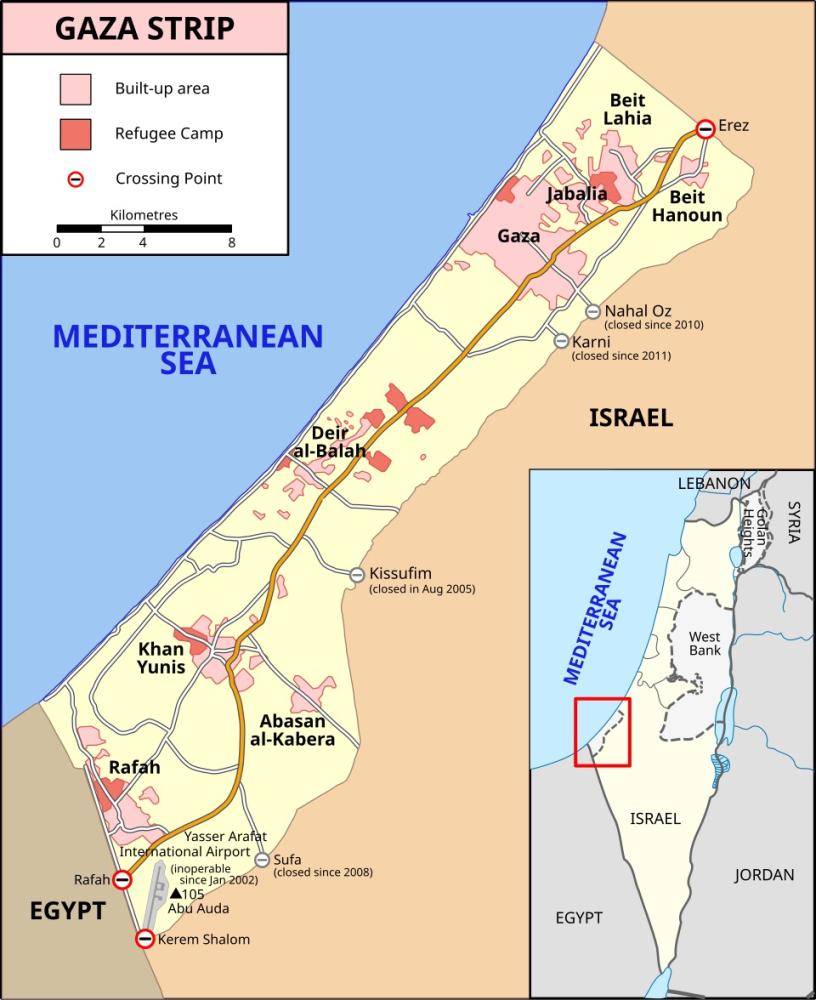
In More Detail: The Gaza Strip was created through armistice lines in the aftermath of the 1948 war. It is a 365-square-kilometer (141-square-mile) coastal territory at the southernmost tip of historic Palestine. To its west is the Mediterranean Sea, to its south is the Egyptian Sinai Peninsula, and to its north and east are regions of historic Palestine seized by the nascent state of Israel in 1948.
The majority of Gaza’s residents today are descendants of Palestinians internally displaced in the 1948 war, during which Zionist militias ethnically cleansed nearly 1 million Palestinians to establish the state of Israel. The leadup to, and events of, the 1948 war marked the beginning of the Nakba (Arabic for catastrophe), the systematic process of forcibly removing and dispossessing Palestinians. Palestinians often refer to this as the “ongoing Nakba,” as Israeli expansionism and Palestinian forced displacement continue through the present day.
The Gaza Strip was carved out of the historic Gaza District, which spanned over 1,100 square kilometers (425 square miles). The Gaza District was home to major Palestinian cities, towns, villages, and agricultural lands that were forcefully emptied of Palestinians by Zionist militias in the 1948 war.
As a result, what we now know as the “Gaza Strip” is a modern geographical creation resulting from the violent establishment of the state of Israel in 1948.
How did the Gaza Strip become one of the most densely populated places in the world?
In Brief: The Gaza Strip became one of the most densely populated places in the world because hundreds of thousands of Palestinians were displaced during the 1948 Nakba and sought refuge there. Over decades, Israeli occupation, settlement, and blockade confined the growing population within an increasingly restricted and isolated territory.
In More Detail: As a result of the 1948 war and onset of the Nakba, between 200,000-250,000 Palestinians were forced to seek refuge in the Gaza Strip, a territory that previously had a population of about 80,000.[1] In addition to the Gaza Strip’s absorption of nearly a quarter of a million refugees in 1948, the modern population growth of this territory reflected the context of extreme isolation that, while consistent through the post-1948 period, took various forms.
The Gaza Strip experienced brief, but brutal, conditions during Israel’s occupation of the territory in 1956-57 before enduring Israel’s 38-year occupation and settlement expansion from 1967 to 2005. This was followed almost immediately by Israel’s imposition of an air, land, and naval blockade of Gaza starting in 2007. For much of this period, the broad historical trend was one of Palestinians enduring the violence and dispossession brought on by Israeli expansionism, with the state appropriating Palestinian and Arab land as well as settler expansion. In 2016, Israeli politician Yair Lapid captured the nature of these practices when he voiced his commitment to a status quo of “maximum Jews on maximum land with maximum security and with minimum Palestinians.” Essentially, Israeli space expanded around Palestinians, closing in on them and trapping them in place.
Did the 1948 Nakba impact all Palestinians in Gaza, or only its refugee population?
In Brief: The 1948 Nakba profoundly affected all Palestinians in Gaza because the mass displacement, loss of land, severed economic and cultural ties, and new restrictions on movement reshaped life for both refugees and original residents of the newly formed territory.
In More Detail: The Nakba was a major defining moment for all in the newly formed Gaza Strip, not only out of solidarity with dispossessed refugees but also due to the worsened living conditions imposed on all its residents. By far, the greatest losses and suffering in the Nakba were endured by those forced into refugeehood. The dispossession of Palestinian landowners of Gaza was also significant and consequential; they owned farms or had made the highly sought-after investments into orange groves or other agricultural lands in the Gaza District, Yafa, and elsewhere, or owned businesses or property in other parts of Palestine.
In order to assess the impact of the Nakba on life in the Gaza Strip, it is important to understand the scale of loss in 1948 and the changes that were imposed on Gaza’s residents. Here are some ways that the ethnic cleansing of particular sites, from which many refugees in Gaza today descend, meant for all Palestinians in the newly established territorial unit:
- Majdal ‘Asqalan, or Al-Majdal was a coastal city and important commercial center in southern Palestine, known for its factories and textile production, where workers had highly specialized skills and worked in trades. Not only did business owners lose their property, but workers from the city and its environs lost access to their jobs, materials, goods, and markets to sell their goods. It is so close to the Gaza Strip that Palestinians originally from the city can see it when standing on a rooftop. Majdal `Aqsalan was renamed Ashkelon by Israel following its conquest.
- Yafa was a port city on the Mediterranean coast and cultural capital in pre-Nakba Palestine. Its vast orange groves within and just outside the city made it a hub for the citrus trade. In fact, at the twilight of the nineteenth century, citrus fruits became Palestine’s main export. Palestinians of Yafa were forced to flee their homes, with many ultimately seeking refuge in the present-day Gaza Strip, Jordan, and elsewhere. Yafa is often romanized as Jaffa. After Israel conquered and expelled Yafa’s residents in 1948, it was annexed to Tel Aviv, whose official name is Tel Aviv-Jaffo.
- Bi’r al-Sab` was a small Palestinian city and trade hub. Despite the city’s modest size, it was the namesake of the largest district of pre-Nakba Palestine, the Beersheba District—the romanized form of Bi’r al-Sab'—which was 12.5 million dunums (approximately 4,826 square miles) in size. The district included the expansive Naqab (Negev) Desert, home to Bedouins who lived in the region for centuries. Most of the Bedouin community of Bi’r al-Sab` was forcibly expelled to the present-day Gaza Strip, while others were displaced to the Egyptian Sinai Peninsula, Jordan, or the West Bank. The Nakba brought with it forced sedentarization and a harsh rupture with cultural practices that are still mourned until the present day. After Israel conquered and ethnically cleansed the Palestinians of Bi’r al-Sab`, it renamed the city to Be’er-Sheva.
There was also the loss of access to urban life in Palestine’s cities, severing residents of the Gaza Strip from their connections to cultural institutions, houses of worship, economic life, ports, and more. Further, residents of the Gaza Strip faced severe isolation, losing their freedom of movement. For example, they previously had the ability to travel using the railway system and network that once connected the present-day Gaza Strip to the remainder of historic Palestine and to neighboring Arab countries.
Finally, the Nakba created permanent physical barriers that separated families, as some extended families lived in different parts of historic Palestine (and even the broader Levant region) prior to the Nakba and traveled to visit one another. Not all refugee families remained intact as they fled brutal violence at the hands of Zionist militias in 1948. It is not uncommon for Palestinian families in other parts of historic Palestine or neighboring countries to have a branch of their family in the Gaza Strip.
What characterized Israel’s occupation of the Gaza Strip and settlement enterprise from 1967 to 2005?
In Brief: From 1967 to 2005, Israel’s occupation and settlement enterprise in the Gaza Strip was marked by severe military repression, illegal settlement expansion, land and resource theft, movement restrictions, and systemic human rights violations that subjugated over one million Palestinians to benefit a small population of Israeli settlers.
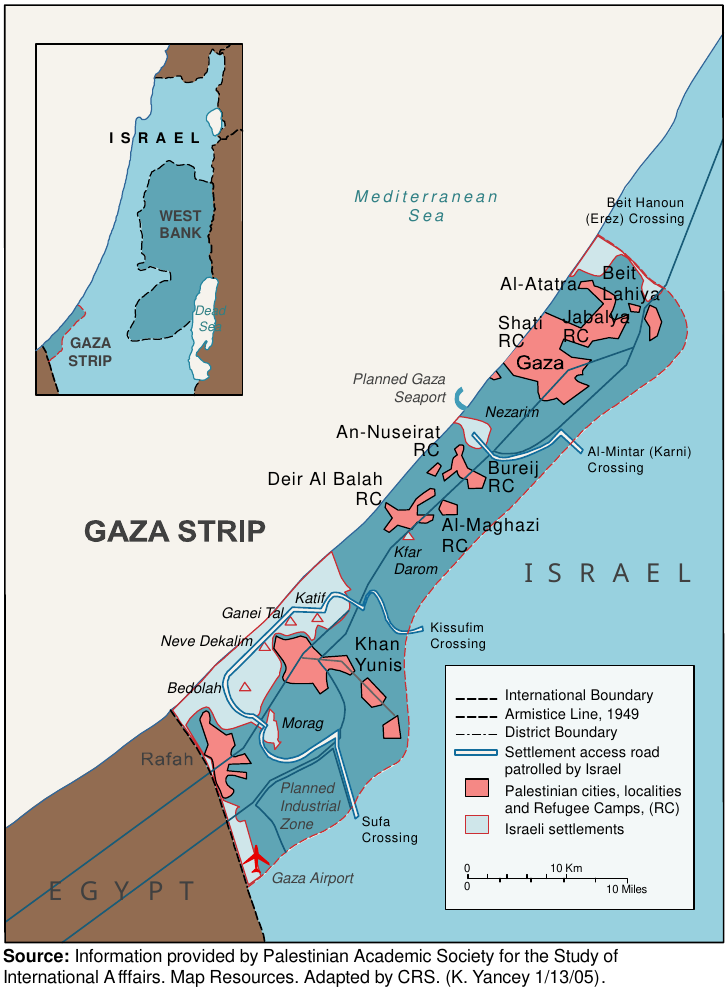
In More Detail: Israel instituted its occupation of East Jerusalem, the Gaza Strip, and the West Bank as well as the Egyptian Sinai Peninsula and the Syrian Golan Heights as a result of the June 1967 war. In 1970, Israel established its first settlement in Gaza, building a settlement enterprise that remained in place until 2005. At the time of Israel’s withdrawal from Gaza and removal of its settlements, about 9,000 Israeli citizens lived in 21 settlements throughout the Gaza Strip, a violation of international law.
The tone of Israel’s occupation was set by historical precedent. As a result of the 1948 war, Egypt administered the Gaza Strip. However, during the Tripartite Aggression on Egypt, also known as the Suez Crisis, in which Israel, Britain, and France invaded Egypt following its nationalization of the Suez Canal, Israel briefly occupied the Gaza Strip from November 1956 to April 1957. During this period, known as the First Israeli Occupation of Gaza, Israel brutalized the Palestinian population of Gaza, and committed two massacres: the Rafah Massacre, in which it rounded up and executed 275 Palestinians, and the Khan Yunis Massacre, killing over 100 Palestinians.[2]
The Second Israeli Occupation of the Gaza Strip began in 1967 and was characterized by similar cruelty and disregard for Palestinian human rights and international law. Gaza was subjected to the same violence imposed on occupied East Jerusalem and the West Bank: no freedom of movement within or outside of the territory including the establishment of checkpoints and enforcement of road closures for days on end; internal fragmentation imposed by military checkpoints and settlements; fragmentation from other Palestinian territories and the surrounding region; economic exploitation and subjugation; destruction of infrastructure; the constant threat of lethal force; home demolitions; and administrative detention (arresting and placing Palestinians in military prisons without charge or due process).
The imposition of illegal Israeli settlements in the Gaza Strip negatively impacted Palestinians in virtually all aspects of life. Settlements were highly guarded and, as a result, limited Palestinian urban planning in the tiny geographic territory. This meant that over one million Palestinians were denied access to 30 percent of land in Gaza to privilege 9,000 Israeli settlers. To perpetuate its military occupation and settlement enterprise, Israel stole access to water and fertile lands. The Israeli military inflicted violence against Palestinians; it often damaged or destroyed Palestinian homes, property, and farmland. In certain parts of the Gaza Strip, the placement of settlement blocs on the coast, in combination with the checkpoints littered throughout the Gaza Strip that severely limited Palestinians access to other parts of the territory, denied Palestinians access to the seashore and their ability to fish.
Israel claims that it “gave” Palestinians Gaza when it withdrew from its Gaza settlements in 2005, but did Israel ever really leave Gaza? In other words, did Gaza remain an occupied territory after 2005?
In Brief: Israel never truly left Gaza. Even after dismantling its settlements in 2005, it continued to control Gaza’s borders, airspace, sea access, trade, and security, maintaining the territory’s occupied status through indirect but comprehensive domination.
In More Detail: In 2005, Israel “disengaged” from the Gaza Strip, dismantling its settlements in August and its remaining military and settlement infrastructure in September. Israeli Prime Minister Ariel Sharon’s decision drew criticism from the Israeli right. On the surface, the Gaza “disengagement” appeared to be a step in favor of the “peace process” and toward the implementation of international law, ending the military occupation of the Gaza Strip, removing illegal Israeli settlements, and allowing Palestinians freedom of movement and a reprieve from the threat of violence from an occupying army. However, as Ariel Sharon’s advisor, Dov Weisglass, told Haaretz, a leading Israeli newspaper, the objective of the disengagement plan was “‘the freezing of the peace process,’” adding:
"...when you freeze that process, you prevent the establishment of a Palestinian state, and you prevent a discussion on the refugees, the borders and Jerusalem. Effectively, this whole package called the Palestinian state, with all that it entails, has been removed indefinitely from our agenda. And all this with authority and permission. All with a presidential blessing and the ratification of both houses of Congress.”
According to Weisglass, by 2003, the government was constrained by economic stagnation, the controversy surrounding the publication of “The Pilots’ Letter” by members of the Israeli Air Force who refused to conduct airstrikes on Palestinians, and general pressure in the international community for Israel to abide by its obligations to international law and the Oslo Accords. The Gaza withdrawal was intended to mitigate pressure on Israel to halt its settlement enterprise in all Palestinian territories, freeing up Israeli resources to focus on its occupation of and settlement expansion within the West Bank, and to evade its commitments to both the Oslo Accords and the George W. Bush administration’s Road Map to Peace. Effectively, Israel wanted to control Gaza indirectly in order to focus its resources on direct rule over the West Bank.
To be sure, Palestinians in Gaza celebrated the Israeli withdrawal as a victory: settlements no longer monopolized huge chunks of the small territory or obstructed their access to the shore, and Israeli military checkpoints no longer blocked roads for days on end or fragmented entire regions of the Gaza Strip from one another. However, Israel still maintained total control over the territory’s access to the outside world and threatened violence on its population at any time. Some of the ways Israel maintained its control over Gaza in the aftermath of its “disengagement” included:
- Controlling Trade: Israel exercised total control over Gaza’s imports and exports, keeping the territory a captive market for Israeli goods and limiting the ability of Palestinians to export their crops and products to the outside world.
- Limiting Sea Access: Palestinian fishermen in Gaza were only allowed to fish up to 10 nautical miles from the coastline--despite the agreement under the Oslo Accords that fishermen would be allowed access to 20 nautical miles--and they faced the constant threat of lethal force from Israeli naval gunboats.
- Imposing a Military Buffer Zone: Israel created a military buffer zone in Al-Siafa, a neighborhood of Beit Lahia at the most northwest point of the city, and surrounding areas in northern Gaza in the final years leading up to the disengagement.
- In December 2005, the Israeli military dropped threatening leaflets on Palestinians in Gaza to stay out of the buffer zone. About 5,000 Palestinians were impacted, and by insisting on their right to live in their homes, residents had to adopt strategies to avoid Israeli air strikes and artillery fire. As explained by the UN Office for the Coordination of Humanitarian Affairs (OCHA):
"Al Siafa residents who have stayed in the community have severely limited their movement, including no movement after dark. Critical movement to schools and markets is being made during the daylight hours and only on certain roads. Residents in surrounding areas are being impacted through the IDF enforcement of the “no-go” area with air strikes and artillery shelling and are not able to access their agricultural land inside the area."
In light of this scale of control and violence inflicted on Palestinians following Israel’s withdrawal in 2005, Israel’s disengagement amounted to a change in tactics, but not in its overall strategy: total control of Palestinians between the river and the sea. It continued to pursue the Israeli mission of “maximum land with minimum Palestinians” through violence and settlement expansion by rearranging the mechanisms put in place to accomplish these goals.
Why did Israel place the Gaza Strip under blockade in 2007?
In Brief: The blockade devastated life for Gaza’s 2.2 million Palestinians by turning basic needs like electricity, clean water, medical care, work, and travel into daily struggles, creating chronic humanitarian crises, high unemployment, and preventable deaths as part of a deliberate system of long-term deprivation.
In More Detail: Israel’s blockade of Gaza, imposed in 2007, is the longest-running siege in modern history, impacting every person living in the Gaza Strip. When the 2007 blockade began, the population was 1.4 million. By 2023, Gaza’s population was about 2.2 million. During this period, a new generation was born, another came of age, and many died as a result of the manufactured humanitarian crisis and Israel’s successive wars on Gaza in 2008-9, 2012, 2014, and 2021. In these four wars, Israel killed nearly 3,000 Palestinians in Gaza, 897 of whom were children, leaving a bereaved society to pick up the pieces each time. Palestinians in Gaza attempted to rebuild their communities while the international community failed to pressure Israel to alleviate the burdens of the blockade and allow for proper reconstruction.
The blockade intruded into every aspect of life in Gaza. Daily routines including access to food, water, medicine, and travel (especially for education or medical treatment), having electricity at home, and finding employment were completely controlled by the blockade. By 2017, households in Gaza could count on no more than four hours of electricity per day. Water shortages impacted all Palestinians in Gaza. Excessive extraction contributed to saltwater intrusion and that, combined with contamination from wastewater, left 97 percent of Gaza’s sole natural water supply, the Coastal Aquifer, unsafe for human use. This contributed to a severe environmental crisis, as Israel blocked the import of vital resources and equipment necessary for sustaining and improving water sanitation infrastructure. As a result, around 90–95 percent of Gaza’s groundwater became contaminated and unsuitable for drinking, primarily due to sewage pollution and seawater intrusion.
As a result of the blockade and prior to the ongoing genocide, Palestinians in Gaza faced a chronic unemployment crisis, particularly among youth. In 2021, the overall unemployment rate stood at 47 percent, with youth unemployment reaching 64 percent.
Israel isolated Gaza from the outside world and severed the rest of the world’s connections with Gaza. One manifestation of this system of control affected students admitted to foreign universities who often risked their admission, and sometimes their scholarships, either because Israel arbitrarily delayed their travel permits to attend visa interviews at foreign consulates in Jerusalem, or because their exit permits were denied or delayed by Israel.[3]
Due to Israel’s blockade and decades of what sociologist Sara Roy termed economic de-development in the Gaza Strip–a deliberate policy of rendering the Gaza economy dependent on Israel, preventing exports, top-down impoverishment, and disenfranchisement–Gaza’s health sector struggled to keep up with public health needs. Through its refusal to allow adequate medical equipment, technology, and medications into Gaza, Israel engineered a scenario which turned treatable diagnoses into terminal illnesses.
The most common and well-documented aspect of this policy involved cancer patients.[4] In virtually all cases in Gaza, a cancer patient’s only chance at survival was securing a permit to travel to the West Bank or East Jerusalem for treatment. Each year, international organizations documented the rising number of patients in Gaza who applied for medical exit permits that were either rejected or ignored. According to a 2017 report, 54 patients died in Gaza while waiting for travel permits; 46 of them were cancer patients. In 2022, B’Tselem reported that the Israeli government denied over 20,000 travel permit applications for patients and caretakers, a figure that includes rejected permits for 1,906 children. In 2023, the Palestinian Centre for Human Rights reported that 350 children with cancer were at risk due to inadequate facilities in Gaza and who, even if granted travel permits to hospitals outside of the territory, were often forced to travel and undergo medical treatment alone, without a parent or guardian, due to Israel’s high rejection rates for caretaker permits.
While these aspects do not fully capture the extent, scale, and impact of the blockade, they illustrate that it was not merely a collection of arbitrary policies fluctuating over time. Rather, the blockade of Gaza formed part of a far-reaching and complex structure of oppression deliberately implemented by Israel.
By 2017, humanitarian conditions in Gaza reached their peak due to the worsening of Israel’s blockade. How did Palestinian civil society respond?
In Brief: Amid worsening humanitarian conditions in 2017, Palestinian civil society organized the Great March of Return, a mass grassroots movement that began on March 30, 2018, demanding an end to the blockade and the right of return for refugees, reflecting growing frustration with international inaction and a renewed focus on the root causes of their struggle.
In More Detail: The ten-year anniversary of Israel’s blockade of Gaza in the summer of 2017 coincided with two major transformations.
First, there were consequential shifts in US policy that completely denied the legitimacy of Palestinian refugee status. Early in the first Trump administration, the State Department was directed to prepare for significant cuts to US funding for UN agencies. The Israeli government had waged a longstanding campaign against UNRWA (United Nations Relief and Works Agency for Palestine Refugees) and wanted to ensure that funding to UNRWA would be subjected to these cuts in US aid. UNRWA is an agency that provides food aid, schooling, and medical treatment to many Palestinians in Gaza. By the summer of 2017, Netanyahu announced his intentions to completely dismantle the agency as part of Israel’s campaign of delegitimizing the refugee question and evading responsibility to uphold UN Resolution 194.
Second, a wave of protests in Jerusalem against a proposed Israeli policy to install metal detectors in the Aqsa Mosque compound and throughout occupied East Jerusalem resulted in victory when Israel backtracked on its plans.
In Gaza, members of civil society reflected on the challenges threatened by Washington and the opportunities presented by the popular Palestinian victory in Jerusalem. Meanwhile, one Palestinian writer, Ahmed Abu Artema, shared his reflections on the cruelty of borders, permanent refugeehood, and Gaza’s isolation from the world. His social media posts sparked a lively conversation among Palestinians in Gaza who reflected on these broader issues. This culminated in a decision to start a protest movement that focused not on the most recent aspect of their struggle--namely, the blockade--but the root cause of their suffering, from which all other struggles like the blockade emerge: the unresolved question of permanent refugeehood and the ongoing Nakba.
The accumulation of political concerns, combined with the worsening humanitarian situation on the ground, eventually culminated in the grassroots mobilization effort known as the Great March of Return. Coinciding with Land Day 2018, Palestinian civil society, including youth groups, community organizations, and cultural associations, organized the Great March of Return, where tens of thousands of Palestinians protested peacefully toward the border fence with Israel to highlight two demands: an end of the blockade, and the implementation of the Palestinian Right of Return as safeguarded by UN Resolution 194.
The Great March of Return became a weekly occurrence. Every Friday, Palestinians in Gaza, many of them from refugee families, marched to the border fence to protest the consequences of the ongoing Nakba–which include the humanitarian crisis presented by the blockade–and to demand return to their original cities, towns, and villages in historic Palestine. Protesters danced the dabka, recited poetry, held reading circles, and hosted listening sessions for Palestinian elders to share their memories of life in Palestine before the Nakba.
In response to these unarmed protests, Israeli snipers targeted everyone, from Palestinian youth to the elderly, journalists, and medics. Israel’s heavy-handed response sent shockwaves throughout the world, that even western media sources typically hostile to Palestinians began to moderate their pro-Israel bias (though for a limited time only). Israel’s assassination of Razan Al-Najjar, a 20-year-old Palestinian medic who was shot and killed by an Israeli sniper, drew condemnation. Shortly thereafter, the Israeli human rights organization B’Tselem concluded their investigation into the killing, ruling that Al-Najjar was intentionally targeted by the Israeli military. Later, the New York Times published a front-page feature and visual investigation that pieced together footage from the protests, conducted eyewitness interviews, and modeled the scene of the shooting, concluding that the Israeli military intentionally shot and killed Al-Najjar.
Israel’s response to the Great March of Return captured the attention of the western media, and for the first time, recognized the plight of refugees and the unresolved refugee question as a major issue defining the politics of and resistance in Gaza. However, while the symbolism was impactful on the popular level worldwide, it did not produce political results. Although the Great March of Return was one of the longest running unarmed protest movements of the twenty-first century, the March failed to generate a proportionate international or regional response to its demands or Israel’s violent crackdown. This lack of engagement and attention contributed to deep frustration among Palestinians in Gaza, reinforcing their sense of isolation and abandonment, and ultimately setting the stage for further deterioration of the reality in Gaza.
If Gaza had cafes and shopping malls under blockade, was it really an “open air prison”?
In Brief: Yes, Gaza was still an “open air prison” because the blockade structurally controlled and restricted every aspect of life, and the presence of a few cafes or malls did nothing to change the reality of mass confinement, limited movement, collapsing infrastructure, and deliberate economic strangulation.
In More Detail: The existence of isolated signs of consumer activity between 2007 and 2023 do not negate the reality of the blockade, or that the blockade had severe humanitarian consequences as documented in many reports by UN agencies and committees, as well as respected international NGOs. The blockade is not defined by the total absence of goods or the total lack of economic activity; rather, it is defined by the systematic restriction of movement of people, resources, materials, and goods. It regulated and controlled every aspect of life in Gaza, as detailed above. Even when consumer goods were occasionally allowed into Gaza, their availability was inconsistent and not accessible to large segments of the population. In other words, using the presence of small luxuries like aesthetically pleasing cafes, beachfront restaurants, and shops to argue that the blockade was a myth is a logical fallacy that denies what the Israeli government itself has explicitly acknowledged as its strategy in Gaza. Take, for example, a 2016 report in Haaretz based on Israeli Military Intelligence Chief Herzi Halevi’s comments to Members of Knesset (MK):
"The MKs noted that the military intelligence chief made it clear that as of today Hamas is doing everything it can to stop an escalation against Israel in Gaza. He said Hamas is functioning as a restraining force for other organizations in Gaza and is making an effort to prevent rocket fire. Still, they said that Halevi made it clear that economic improvement in Gaza will be the most important restraining factor.
‘The military intelligence chief said that the situation in Gaza is deteriorating, and that the United Nations report forecasts a catastrophe,’ said one of the MKs. ‘He emphasized to us that if there won’t be improvement Israel will be the first to feel it when things explode.'"
In other words, the goal of the Gaza blockade was to maintain the status quo in Gaza: never allow conditions to deteriorate enough to actually starve the population, but to merely hover just above a humanitarian crisis, and to allow minor economic improvements from time to time to prevent Palestinians or the international community from reacting in such a way that might disrupt this status quo.
The blockade’s effects were structural, not cosmetic. It crippled public services and infrastructure, restricted freedom of movement, and disrupted and ruptured Gaza’s connection to Palestinian, regional, and global economies. Pointing to a mall or cafes as evidence against the blockade is a misrepresentation of the broader socioeconomic conditions that the great majority of Palestinians in Gaza endured.
How has Israel’s genocide in Gaza impacted and transformed the Gaza Strip?
In Brief: Since October 2023, Israel’s genocide transformed the Gaza Strip by destroying most of its infrastructure, forcibly displacing the vast majority of its population, collapsing social, institutional, medical, and educational life, and inflicting long-term physical, environmental, cultural, and psychological damage aimed at erasing Gaza’s society and future.
In More Detail: Israel’s continuing policy of genocide in the Gaza Strip is unprecedented in terms of its violence, brutality, scale, and intensity. Unlike previous Israeli wars on the Gaza Strip, the ongoing genocide has led to the near or total destruction, annihilation, and erasure of entire cities, towns, communities, and neighborhoods of the Gaza Strip.
The goal of Israel’s military operations in Gaza appears to be twofold: first, the extensive and potentially irreversible destruction of the Gaza Strip; and second, the widespread displacement of its Palestinian population, as indicated by reports referencing the Israeli operational plan known as “Gideon’s Chariots.” This assessment aligns with evaluations by the United Nations and international organizations documenting extensive destruction and displacement. Approximately 70 percent of Gaza’s infrastructure—including homes, schools, hospitals, and commercial establishments—has been severely damaged or destroyed. The scale of devastation is underscored by the UN Development Programme (UNDP), UNICEF, OCHA, and the International Committee of the Red Cross (ICRC), which estimates that reconstruction efforts will require about $70 billion, with housing as the most affected sector. Additionally, Israel’s destructive military campaign has created over 61 million tons of debris and rubble, according to the UN Environment Programme (UNEP), which poses long-term environmental and health hazards. The UNEP and the UNDP project that clearing up this debris will require up to fourteen years and between $500 and $600 million, significantly prolonging the displacement of the local population. The UN has further documented that about 90 percent of Gaza’s population—approximately 1.9 million people—have been forcibly displaced by the genocide. A preliminary assessment issued by the UNDP in July 2024—as Israel continued to wage full-scale attacks and destruction on the Gaza Strip—predicted that full reconstruction cannot be expected until the year 2040, underscoring the long-term implications of Israel’s military actions and highlighting the substantial, intentional obstacles to recovery and return. The European Union (EU) and UN issued a report in April 2026 projecting that Gaza's reconstruction will cost an estimated $71.4 billion over the next decade, and noted that a “catastrophic impact on human development,” which according to their estimation, has been “set back by 77 years.”
Beyond the physical destruction of buildings and infrastructure, the ongoing genocide in Gaza has deeply impacted societal structures, health, and community cohesion, according to reports by international organizations. In May 2024, the UNDP emphasized severe disruptions to essential services including education, healthcare, and social infrastructure, highlighting that human development in Gaza has been set back by decades—an assessment reinforced in post-October 2025 ceasefire reports, as noted above. The healthcare system has completely collapsed, with severe shortages of medical supplies and widespread malnutrition, particularly among children. Additionally, mental health has deteriorated significantly. A United Nations expert raised alarms about escalating mental health crises caused by continuous violence and trauma. The Office of the UN High Commissioner for Human Rights (OHCHR) further notes that the war in Gaza has led to the erosion of social order, including widespread looting and unlawful violence, due largely to the destruction of local institutional capacity to uphold public safety and civil order. In addition, Israel’s systematic destruction of cultural heritage sites, such as mosques, churches, and museums, has significantly damaged Gaza’s historical and cultural identity. Together, these factors indicate a deliberate strategy aimed not only at physical devastation but also at undermining Gaza’s societal fabric, effectively displacing its population, destroying its historical and cultural existence, and erasing its past and present and preventing its future.