Topics:
Research Guide: Palestine in US Policy
Table of Contents
Table of Contents
Are you a researcher looking for reputable sources on Palestine in US policy? Our guide has sources for a diverse set of researchers—from students looking for secondary sources like peer-reviewed academic journals, to journalists seeking reliable databases, to specialists producing knowledge in academia or in the information space. Find publications, databases, archives, and more on the following subthemes:
- US support for Israel
- US-Palestinian relations
- Palestine in foreign policy
- Palestine in domestic policy
- Palestine in electoral politics
- Palestinian Americans
- Repression of Palestine organizing in the US
Academic Journals
A note for students: our guide features two types of peer-reviewed journals, those that require an individual subscription or access via your institution, and open-access journals.
Open-access journals are accessible to all researchers, free of charge.
For access to paywalled journals, check to see if your university subscribes to the journal you are interested in, which will grant you physical and/or digital access. If your university does not provide institutional access to any of the journals listed below, here are some options that might be available to you:
- Submit a request to your librarian to acquire institutional access, or to purchase access to a particular issue of the journal you are interested in.
- Submit a scan-and-deliver request for the particular article you would like to read. Some universities have resource sharing agreements with one another and will fulfill requests for article scans, as well as scans of book chapters (limits apply due to copyright laws; consult your library policy guidelines).
- Occasionally, paywalled journals will offer free access to selected articles in a particular issue, or free access to selected issues.
University librarians often consider requests from library patrons to acquire institutional access to books and academic journals.
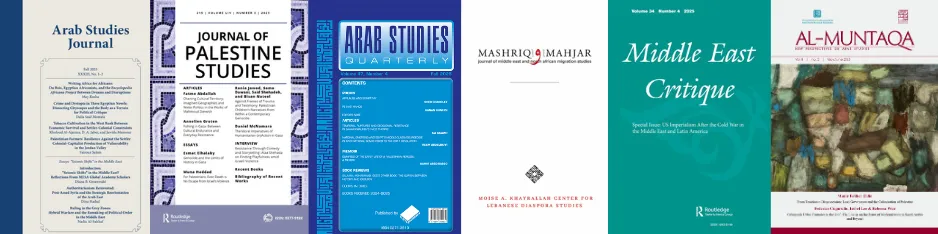
Peer-reviewed academic journal published by the Arab Studies Institute (ASI), the parent organization to other initiatives including the Jadaliyya e-zine. ASJ is affiliated with Georgetown University’s Center for Contemporary Arab Studies (CCAS). Subscription/institutional access required.
Peer-reviewed academic journal co-founded by Palestinian American intellectuals Edward Said and Ibrahim Abu-Lughod in 1979. The establishment of ASQ emerged from a need to challenge pervasive orientalism and (largely unchecked) anti-Arab bigotry in US academic publications. ASQ was born out of the Association of Arab American University Graduates (AAUG), a grassroots political organization that operated from 1967 to 2007; it was dedicated to promoting decolonization in the Arab world, global anti-imperialist solidarity, and Palestinian liberation. Subscription/institutional access required for issues published between 1979 and 2007; open access for all issues published since 2008.
Peer-reviewed journal of the Society of Historians of American Foreign Relations (SHAFR). Subscription/institutional access required.
International Journal of Middle East Studies (IJMES)
Peer-reviewed journal of the Middle East Studies Association (MESA), a leading professional association for scholars and experts on the region. Subscription/institutional access required.
Peer-reviewed journal of the Institute for Palestine Studies (IPS), a research organization established in 1963 that also publishes the Arabic-language journal Majallat al-Dirasat al-Filastiniyya and Jerusalem Quarterly. Subscription/institutional access required.
Mashriq & Mahjar: Journal of Middle East and North African Migration Studies
Peer-reviewed journal of the Moise A. Khayrallah Center for Lebanese Diaspora Studies at North Carolina State University. Useful resource for academic publications on Arab Americans and Palestinian Americans. Open access.
Peer-reviewed journal that promotes interdisciplinary approaches to the study of the region with a commitment to “heterodox theoretical perspectives” in advancement of knowledge production on the region. Open access.
Peer-reviewed journal of the Middle East Policy Council, a non-partisan educational organization focused on US interests in the Middle East. Dedicated to assessments of US policy in the region and how these policies align with national interests, Middle East Policy is an important forum for researchers interested in foreign affairs. Subscription/institutional access required.
Al-Muntaqa: New Perspectives on Arab Studies
Peer-reviewed journal of the Arab Center for Research and Policy Studies (ACRPS) and the Doha Institute for Graduate Studies. Open access.

Academic Associations
Academic associations are membership-based organizations that convene scholars and experts of particular fields or disciplines, often organizing conferences, workshops, sponsoring research, and publishing journals and other digital resources. Visit relevant academic associations listed below to find information on the state of the field, research guides, bibliographies, and recently published scholarship; connect with scholars; and view opportunities for research grants.
Relevant Academic Centers, Initiatives, and Research Organizations
For expert analysis, access to reports, announcements on new publications in the field of Palestine studies, research guides, finding aids, methodological primers, informative digital projects, and more, visit the sites of the following organizations:
- Arab Center for Research and Policy Studies (ACRPS)
- Arab Center Washington DC (ACW)
- Arab and Muslim Ethnicities and Diasporas Studies (AMED), San Francisco State University
- Center for Palestine Studies (CPS), Columbia University
- Institute for Palestine Studies (IPS)
- Librarians and Archivists with Palestine (LAP)
- Middle East Studies Association (MESA)
- New Directions in Palestinian Studies, Brown University
- Palestinian American Research Center (PARC)
- Project on Middle East Political Science (POMEPS), George Washington University
Public Opinion Polls
Public opinion polls are an important resource for observing trends and changes over time in general attitudes on various political issues. Conducting surveys is an important method in the fields of political science and sociology. Policy analysts, journalists, and academics often refer to public opinion data in their publications. For information on how public opinion polls are conducted and guidance on how to interpret survey data, check out this free course offered by the Pew Research Center.
Annual public opinion survey conducted by the Arab Center for Research and Policy Studies (ACRPS) on Arab views of regional political affairs, with questions on Palestinian rights, Israeli human rights violations, and the US role in the Palestinian plight regularly appearing in annual survey data. Useful resource for international views on US policy on Palestine, Arab attitudes toward the US due to policy on Palestine, and US-Arab affairs at large. Some surveys conducted in partnership with Arab Center Washington DC (ACW) include “Arab Public Opinion about the Israeli War on Gaza” (2024) and “Arab Public Opinion and US Presidential Elections 2016.” Datasets are available for download.
Research network that conducts public opinion surveys in the Arab world on regional and international issues, with some surveys focusing on the question of Palestine and views toward the US as a result of its support for Israel.
Gallup polls are a commonly cited source for public opinion data on various issues, including US public opinion, US public opinion on Middle East affairs, US public opinion on Israel-Palestine, and more. Subscription/institutional access required, but some data sets and insights are available to the public free of charge.
The Palestinian Center for Policy and Survey Research (PSR)
Think tank dedicated to policy analysis, public opinion polling, and survey research. Conducts authoritative surveys on Palestinian public opinion on a number of issues, including the US role in facilitating the Israeli occupation, Israeli human rights violations, and Palestinian statelessness.
Commonly cited source for public opinion data and survey research. US public opinion polls on the Middle East, views on Israel and its treatment of Palestinians, and voter behavior are relevant to researchers interested in US policy on Palestine. Datasets are available for download.
University of Maryland Critical Issues Poll
Poll conducted on domestic and international affairs that are relevant to policy debates, including but not limited to the Middle East, Israel, and Palestine. Publishes reports based on this expert research. The Critical Issues Poll administers the Middle East Scholar Barometer, a series of polls in partnership with the Project on Middle East Political Science, at George Washington University, which examines the views of scholars on contemporary political issues.
Databases
The following databases contain source material that is relevant to a diverse set of researchers including students, scholars, journalists, and policy analysts. Includes sources applicable to both historical and contemporary studies.
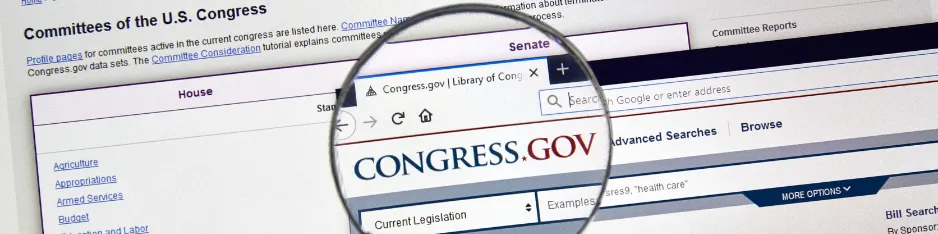
Official database for information on US legislation from 1974 to the present day, continuously updated based on current developments in the House of Representatives and the Senate. Important first step for research on Palestine in US policy and relevant legislation. The site is managed by the Library of Congress through cooperation with record keepers in the Senate and the House of Representatives. It contains tutorials on how to use the site as well as information on the legislative process at large.
Congressional Monitor, Institute for Palestine Studies (IPS)
The Congressional Monitor is a resource dedicated to tracking all proposed legislation on Palestine, Israel, and the "Arab-Israeli conflict" between the years of 2001 and 2018, offering basic facts on the legislation, full texts, and summaries. In addition to a searchable database, the project also includes annual reports on US legislative activity on Palestine, which were published by the Journal of Palestine Studies and are available as open-access PDFs. This is a useful resource for advanced researchers and beginners to the topic alike. The site features valuable explainers on how Congress functions, the legislative process, types of resolutions, Congressional committees, foreign aid, Congressional record keeping, and more in its FAQ section. Note: the Congressional Monitor directs visitors to the Library of Congress's THOMAS repository for legislative information. This site was replaced in 2016 by Congress.gov, which is the current repository for legislative information from 1974 to the present day.
A collection of resources produced by the Foundation for Middle East Peace on anti-BDS legislation in the US and attacks on First Amendment rights, with informative materials on the "Antisemitism Awareness Act," the "Israel Anti-Boycott Act," the “Combating BDS Act," legislation at both the state and federal levels, and efforts to stifle BDS organizing on college campuses.
Collection of data produced by the UN Office for the Coordination of Humanitarian Affairs (OCHA) to assist humanitarian aid organizations as they carry out their work. Resources include maps such as “West Bank Access Restrictions” and “Gaza Strip Access and Movement,” “Data on demolition and displacement in the West Bank,” “Gaza crossings: movement of people and goods,” “Electricity in the Gaza Strip,” and “Gaza Strip: Critical Humanitarian Indicators.” Full databases are limited to humanitarian agencies, but other data is made available to the public. Additionally, OCHA publications like the “Humanitarian Situation Update,” “Humanitarian Response Update,” and “Reported impact snapshot” are important resources for following unfolding developments on the ground and understanding the impact of US military financing provided to Israel.
Defining Criticism of Israel as Antisemitism – Foundation for Middle East Peace (FMEP)
Table that tracks legislation introduced at both the federal and state levels that claims to be aimed at combating antisemitism, but in practice, aims to repress and criminalize protest, activism, and speech critical of Israel and Zionism. Includes legislation passed from 2016 through 2024.
Table with detailed information on anti-boycott laws introduced to counter speech critical of Israel, produced by the Foundation for Middle East Peace. Categorizes laws by areas of focus including the oil and gas industry, the firearms and ammunition industry, timber, mining, agriculture, and more. Document includes an extensive list of articles on anti-boycott laws published between 2016 and 2023.
Government database of the United States Government Publishing Office (GPO) that makes official documents of the three branches of the US federal government available online, free of charge. Available collections include the Congressional Record Index, the History of Bills, the Journal of the House of Representatives, the Public Papers of the Presidents of the United States, Supreme Court Decisions, United States Courts Opinions and more. Other relevant collections for research on Palestine in US policy can be found in this list.
Military & Government Collection, EBSCO
Database of journals and periodicals that publish materials on the US military and government. Many of the journals here reflect the position of the US government and policy establishment on the US-Israel alliance, aid to Israel, and US-Palestinian relations, but nonetheless constitute a reference point on US policy over time. Subscription/institutional access required.
Public opinion poll database on a wide array of issues, including foreign policy. Subscription/institutional access required. Some local libraries subscribe to this research database; check with your local library to see if this resource is available through their catalog.
Political Science Database, Proquest
Database for journals in the fields of political science and international relations, policy papers, dissertations, and country reports. Subscription/institutional access required.
Settlement Reports – Foundation for Middle East Peace (FMEP)
Documentation project of the Foundation for Middle East Peace that tracks Israeli settlement activity. Database contains quarterly reports on settlement activity in East Jerusalem, the West Bank, and the Gaza Strip (occupied by Israel from 1967 to 2005) that were issued by FMEP from 1991 to 2014. Reports include information on Washington’s position on settlements as it transformed over time, and US complicity. Since 2017, FMEP has issued its settlement report on a weekly basis, also accessible through this database.
World Bank Data Catalog, microdata, visualization tools, debt statistics, and more. Data relevant to research on Palestine at large and Palestine in US policy can be found by using key terms “West Bank and Gaza.” The US played a leading role in the World Bank’s founding in 1944, and according to the World Bank Group site, the US is the “only World Bank shareholder that retains veto power over changes in the Bank’s structure,” and consequently “plays a unique role in influencing and shaping development priorities.” With this in mind, World Bank data on the West Bank and Gaza provide a picture into Washington-approved economic plans for Palestinians, the impact of the so-called “peace process” and Oslo Accords, US-Israel economic ties, and other information and indicators.
World Bank Documents & Reports
Collection contains World Bank documents, reports, publications, research, and legal records relevant to research on Palestine at large and Palestine in US policy. Use key terms “West Bank and Gaza” to find pertinent materials. The US played a leading role in the World Bank’s founding in 1944, and according to the World Bank Group site, the US is the “only World Bank shareholder that retains veto power over changes in the Bank’s structure,” and consequently “plays a unique role in influencing and shaping development priorities.” With this in mind, World Bank documents and reports on the West Bank and Gaza provide a picture into Washington-approved economic plans for Palestinians, the impact of the so-called “peace process” and Oslo Accords, US-Israel economic ties, and other information and indicators.
Digital Archives and Primary Source Collections
The Avalon Project, hosted at the Yale Law School, is a collection of primary source documents relevant to law and diplomacy, available online for free. Contains diplomatic records including UN documents relevant to Palestine in US policy broadly, especially US diplomatic efforts to support Israel. Includes a searchable database. Consult the Avalon Project collection, “The Middle East 1916-2001: A Documentary Record” for key UN Security Council resolutions, UN Mediator on Palestine reports, UN General Assembly resolutions on Palestine, treaties, and other documents.
Digital National Security Archive
The National Security Archive hosted at George Washington University provides digital access to over 100,000 declassified government documents regarding security, intelligence, and foreign policy. While many documents of this nature are available through the National Archives, the Digital National Security Archive hosts its own collection of documents obtained through their filing of Freedom of Information Act (FOIA) requests on particular themes. Hosts a Middle East collection. Some documents are available for free through their “Virtual Reading Room,” while the bulk of the collection is hosted on ProQuest and requires a subscription/institutional access.
Foreign Relations of the United States (FRUS) Series – Department of State, Office of the Historian
Official primary source collection of State Department records, accessible through document collections published in volumes or through a keyword search on the FRUS page. Over 500 FRUS volumes are made available to download free –of charge in ebook format by the Office of the Historian. Volumes are organized by presidential administration, beginning with Abraham Lincoln through Bill Clinton. Collections are not exhaustive document records but selected materials from “Presidential libraries, Departments of State and Defense, National Security Council, Central Intelligence Agency, Agency for International Development, and other foreign affairs agencies as well as the private papers of individuals involved in formulating U.S. foreign policy,” according to the State Department Office of the Historian’s “about” page.
Freedom of Information Act (FOIA) Electronic Reading Room – CIA
Digital archive of declassified Central Intelligence Agency documents through the Freedom of Information Act (FOIA). Pertinent special collections include, “President Carter and the Role of Intelligence in the Camp David Accords” and “President Nixon and the Role of Intelligence in the 1973 Arab-Israeli War.” Other documents pertain to US intelligence records on Palestinians, US-Israel relations, and more.
Interactive Encyclopedia of the Palestine Question – Documents
Joint project of the Institute for Palestine Studies (IPS) and The Palestinian Museum (Birzeit, West Bank) featuring timelines, biographies of key historical figures, interactive maps, and primary sources. Visit the Interactive Encyclopedia of the Palestine Question’s “Documents” page to find historical documents relevant to the broad theme of Palestine in US policy.
Recognition of the State of Israel - National Archives and the Harry S. Truman Library and Museum
Collection of digitized primary sources on US recognition of the Zionist movement and nascent state of Israel; includes documents dated from the years 1943-1974.
United Nations Digital Library
Digital archive of the UN. Includes voting records, official UN records and publications, speeches, oral history interviews, and datasets. Collections relevant to the theme of Palestine in US policy include records of the UN General Assembly (UNGA), human rights bodies, the International Court of Justice (ICJ), and the UN Relief and Works Agency for Palestine Refugees in the Near East (UNRWA).
United Nations Information System on the Question of Palestine
Digital archive of UN, League of Nations (predecessor to the UN), and other political documents related to Palestine from 1915 to the present day. Main landing page lists features including a history section, information on UN Committee on the Exercise of the Inalienable Rights of the Palestinian People website, a legal study on the Israeli occupation, a list of Palestinian civil society organizations affiliated to the committee, digital booklets on UN exhibits on Palestine, and information on Palestine in the UN System detailing all UN bodies, agencies, and committees that work on the different facets of the question of Palestine. Includes materials relevant to Palestine in US policy, such as US hostility towards Palestinians, US policy on Palestinian refugees, US-Israel alliance, and US support for Israel at the UN.
U.S. Intelligence on the Middle East, 1945-2009 – Brill
Primary source collection on US spying and intelligence operations in the Middle East with additional resources including a chronology of US intelligence in the region, bibliography, glossaries, and more. Historical documents accessible through this expansive primary source collection include information on the US-Israel intelligence sharing relationship, US spying on Israel, US concerns about the Israeli nuclear program, tensions between the White House and the CIA over recognition of Israel in 1947, US military involvement in Lebanon to enforce the withdrawal of the Palestine Liberation Organization (PLO) in 1982, and many other themes relevant to Palestine in US policy. Subscription/institutional access required.

Physical Archives
A few notes on using physical archives for your research needs:
- Most archives require appointments in advance of your visit. Check out this guide by the Society of American Archivists on what archives are, how to use archives effectively, and how to plan for your first visit.
- Consult library special collections of nearby colleges and universities for sources pertinent to your research needs in their special collections. While access to university libraries is typically restricted to university affiliates, special collections in libraries are often accessible by appointment in coordination with library staff.
- Many archives and libraries will accommodate requests for digital scans of materials within certain parameters, which are subject to copyright limitations and typically, a copy fee. Consult the archive or library policy to explore if this option is available for your research needs.
Arab American National Museum, Russell J. Ebeid Library & Resource Center
Special collections hosted at the Russell J. Ebeid Library & Resource Center at the Arab American National Museum (AANM) in Dearborn, Michigan contain useful materials on sub-themes related to Palestine in US policy, with a particular focus on Arab and Palestinian American activism for Palestine. Check out the AANM finding aids to explore their holdings. Some materials are digitized; browse their digital catalog here.
Nonprofit archive of progressive activism in the United States that has catalogued and preserved key documents on the Palestinian struggle. Some materials deal with the ongoing Nakba and Palestinian efforts to resist the Nakba and Zionist settler colonialism. The Palestine catalog has the following subcollections: "Arab Perspectives on Palestine," "Anti-Zionism," "Human Rights in Palestine," "International Perspectives on Palestine," "Institute for Palestine Studies," and "Palestinian Revolutionary Organizations." Includes historical documents on US leftist solidarity with Palestine, repression in the US, and US policy on Palestine. Primarily a physical archive (located in Berkeley, California) with some digitized materials as well.
The Library of Congress is the official national library of the US located in Washington, DC. It serves as the research wing for the US Congress, offering support through the Congressional Research Service (CRS), a think tank housed in the LOC that provides research materials and original reports for members of Congress. Additionally, the LOC is the largest library in the world and is free and accessible to the public. It also hosts digital collections. In addition to government records, researchers of Palestine in US policy will benefit from materials housed in the LOC’s expansive African and Middle Eastern Division. Explore the LOC catalog, Research Guides, and digital collections to locate reports, published texts, newspapers, photographs, and other primary and secondary sources.
National Archives and Records Administration (NARA)
NARA preserves, catalogues, and stores documents related to US government history for public access. Find primary sources related to Congress, the Supreme Court, federal agencies, the State Department, the Federal Bureau of Investigation (FBI), the Central Intelligence Agency (CIA), and more. Source types include but are not limited to paper records, photographs, and audiovisual materials. Researchers of Palestine in US policy often visit the US National Archives at College Park, Maryland or the National Archives in Washington, DC to view pertinent sources. However, NARA has several other locations and is responsible for the management of presidential libraries throughout the US. Consult this introductory guide and the National Archives Catalog to identify the location(s) relevant to your project.
United Nations Archives and Records Management Section
Located in New York, the United Nations Archives and Records Management Section provides access to its archives for UN diplomats, UN staff, and the general public. Find materials related to the US voting record at the UN, diplomatic support for Israel including vetoes at the UN Security Council, US role in debates on Palestine, and more.