What is the West Bank?
In Brief: The West Bank, a post-1948 geographic and political unit carved out of historic Palestine, is a fragmented territory where over 3 million Palestinians live under the world’s longest military occupation.
In More Detail: The West Bank is a territory carved out of central and eastern regions of historic Palestine as a result of the 1948 war and the establishment of the state of Israel. To its east is the Jordan River, to its southeast is the Dead Sea, to its southwest is the Negev Desert, and to its north and west are regions of historic Palestine, most of which were seized by the nascent state of Israel in 1948, the remainder seized in 1967.
As a geographic concept, the term “West Bank” came into common usage after the 1948 war and the mass expulsion of Palestinians, known as the Nakba. The term refers to the territory’s location in relation to the historic Jordan River, to distinguish the territory from land across the river that is referred to generally as the “East Bank,” but usually in reference to “Transjordan” (present-day Jordan). The West Bank is a territory separated from the rest of historic Palestine as a result of Israel’s establishment. Although Israel does not have defined borders, de facto boundaries were formed following a series of armistice agreements reached in 1949 between Israel and Arab states following the 1948 war. Known as the “Green Line,” the 1949 Armistice Line was meant to be temporary but has become the de facto border that divides Israel from the West Bank, and Israel from the Gaza Strip. Israel’s refusal to define its borders means that it does not respect these boundaries and actively seeks to conquer more territory. Additionally, these boundaries are sometimes referred to as the “1967 borders,” which existed between Israel and the Palestinian territories until June 4, 1967, before Israel launched the 1967 war on June 5 of that year and conquered more Palestinian and Arab lands. The 1967 borders are often used as a reference point for negotiations in the “peace process.”
While the West Bank is a 5,660-square-kilometer territory (2,185 square miles), a figure that includes the area of occupied East Jerusalem, Palestinians lack access to all of this land due to the presence of illegal Israeli settlements, settlement outposts, Israeli military checkpoints, and the 712-kilometer-long (442 miles) “separation barrier,” which is condemned internationally as the Israeli apartheid wall. In total, at least 40 percent of West Bank land is inaccessible to Palestinians living in the territory.
Today, the West Bank is home to over 3 million Palestinians who, since 1967, have lived under Israeli military occupation, the longest-running occupation in modern history. The consequences of the Israeli military occupation are the threat of death at any time at the hands of Israeli soldiers, no freedom of movement, raids into private homes at any time, arrest and detention without charge, violence and theft of land and resources by Israeli settlers, and the systematic denial of Palestinian human and political rights.
How did the 1948 Nakba impact the West Bank?
In Brief: The Nakba and its 1967 extension, the Naksa, transformed the West Bank into both a refuge for displaced Palestinians and a target of Israeli conquest, establishing the conditions for long-term military occupation that continues to perpetuate expulsion, population loss, and settler-colonial domination into the present.
In More Detail: The Nakba set the stage for several transformations that are consequential for West Bank Palestinians through the present day. The concept of the West Bank as an administrative unit was formed out of the ethnic cleansing of Palestine that began in 1947-1948 and culminated in the establishment of the state of Israel. The West Bank absorbed 280,000 refugees as a result of Israel’s mass expulsion of Palestinians in 1948.
From 1949 until 1967, Jordan formally administered the West Bank and East Jerusalem.[1] As a result of the June 1967 war, in which Israel attacked its neighbors on multiple fronts, Israel instituted its occupation of the Egyptian Sinai Peninsula and Syrian Golan Heights as well as East Jerusalem, the Gaza Strip, and the West Bank. On the eve of Israel’s multi-front provocation in 1967, the West Bank had a population of about 900,000 Palestinians. During the 1967 war, Israel ethnically cleansed 300,000-400,000 Palestinians. In Arabic, the 1967 war is referred to as the Naksa, or “setback,” to describe the defeat of Arab armies, the onset of Israeli occupation, and the mass expulsion of Palestinians—undoubtedly understood as an extension of the Nakba. In fact, many victims of the 1967 expulsions were internally displaced Palestinians who fled to the West Bank during the 1948 Nakba, only to be expelled again, this time from the West Bank to Jordan.
At once, the West Bank lost a significant segment of its population due to the 1967 expulsions, and it also absorbed Palestinians who were ethnically cleansed during the same war. Today, approximately 900,000 West Bank Palestinians are registered refugees with the United Nations Relief and Works Agency (UNRWA). About one-fourth of this population lives in the 18 UNRWA-administered refugee camps in the West Bank.[2]
The Naksa was an extension of the ongoing Nakba due to the mass expulsion of Palestinians and the beginning of direct Israeli military rule, bringing with it a system of routine violence, expansionism, and settler-colonial domination. This process is not just an effect of the Nakba; rather, it perpetuates the Nakba to the modern day. Through the military occupation of the West Bank and East Jerusalem, Israel creates the security infrastructure required to demolish Palestinian homes, destroy communities, displace Palestinians, and facilitate its settlement enterprise in these territories. The result is that more and more Palestinians are uprooted while living under military occupation.
Why did Israel institute its occupation of the West Bank in 1967?
In Brief: Israel’s 1967 occupation of the West Bank was not a wartime accident but the culmination of longstanding Zionist expansionism and decades of deliberate planning, attempts, and ideological commitments to conquer, depopulate, and annex Palestinian land.
In More Detail: To understand why Israel occupied the West Bank in 1967, it is important to consider two factors. First, Israel’s mass expulsions of Palestinians have never been accidental, neither in the Nakba nor in the Naksa. Second, expansionism characterizes Israel’s policies vis-à-vis the Palestinian people and their land as a core tenet of Zionist ideology before the state of Israel’s establishment in 1948, and of all successive Israeli governments until the present day. Years before Israel’s establishment, David Ben-Gurion—who led the Zionist movement in Palestine—oversaw the ethnic cleansing of Palestinians, which later became Israel’s first prime minister–endorsed forced population transfer. Ben-Gurion, “With compulsory transfer we [would] have vast areas…I support compulsory transfer. I do not see anything immoral in it.”[3] Yair Lapid described the same goal in 2016 as “maximum Jews on maximum land with maximum security and with minimum Palestinians.”
In addition to this ideological drive to conquer and expel, Israel’s leaders also discussed expanding into southern Lebanon and the West Bank in October-November 1948, emboldened by a series of successful expulsions of Palestinians from towns and villages in the 1948 war. Prime Minister Ben-Gurion discussed plans to occupy the West Bank in the future with key advisors.[4] Earlier that year, Israeli leaders made a number of attempts on West Bank territory. In July, Ben-Gurion ordered his army to occupy Nablus, but failed.[5] In June, the Israeli military launched Operation Yitzhak, a plan to occupy the West Bank cities of Jenin, Tulkarem, and Qalqilya as well as bridges along the Jordan River, and ordered airstrikes on Jenin and Tulkarem.[6] This followed an attempt by the Israeli military High Command to occupy territory in the northern West Bank, which failed due to the fierce defenses of Iraqi troops stationed in the area.[7] In the years between 1948 and 1967, Israeli leaders lamented the “missed opportunity” to occupy the West Bank and even deliberated annexing the territory at several points during this period.[8] While Israel cited security concerns to justify its occupation of the West Bank in 1967, the persistence of these deliberations and earlier plans to seize the territory indicate that occupation of the West Bank had long been planned and was not a circumstance of war.[9]
What is the military occupation of the West Bank and how does it impact Palestinians?
In Brief: Israel’s decades-long military occupation of the West Bank and East Jerusalem, characterized by martial law, systemic violence, land seizure, mass incarceration, resource theft, and movement restrictions, is the longest continuous occupation in modern history and imposes an apartheid regime that violates international law and permeates every aspect of Palestinian life.
In More Detail: According to international humanitarian law, placing a territory “under the authority of the adverse foreign armed forces” constitutes military occupation. Israel’s direct military rule over the West Bank and East Jerusalem is the longest-running military occupation of any territory in the history of the modern world. Since 1967, Palestinians in the West Bank have lived under the direct control of the Israeli military, where it routinely violates international law and the human rights of Palestinians, impacting virtually every aspect of life in the West Bank. In a 2024 advisory opinion, the International Court of Justice ruled that Israel’s prolonged occupation and discriminatory regime violate international law and human rights, including Palestinians’ right to self-determination. Major features of Israel’s occupation and settlement enterprise, and their harmful effects on Palestinians, include the following:
- Martial Law: Shortly after occupying the West Bank, Israel instituted martial law—drawing from British colonial tactics and the Defense (Emergency) Regulations of 1945—to rule Palestinians with an iron fist. For nearly 60 years, the Israeli military has denied Palestinians the right to movement, assembly, protest, political organization, education, free access to religious sites and worship (impacting both Christian and Muslim Palestinians), due process, legal protections from Israeli military violence and mass incarceration, and more—amounting to a systematic denial of civil, human, political, and religious rights.
- Military and Settler Violence: Palestinians in the West Bank are at constant risk of attack from the Israeli military or armed settlers. Between 2008 and 2025, 2,049 Palestinians were killed due to Israeli military and settler violence. Over 1,000 of these deaths occurred in the two-year period, October 2023-October 2025, and one in five of the victims were children.
- Land and Property Theft and Damage: Israel routinely seizes Palestinian land and forcibly removes Palestinians from their homes and property. Over 40 percent of West Bank land has been seized by Israeli settlers, who have constructed 147 official settlements and 224 unofficial settlement outposts in the territory. Between 1967 and April 2026, Israel demolished 61,995 homes in the West Bank and East Jerusalem, the majority of which were razed to clear land for use by the Israeli military.
- Displacement: The West Bank absorbed internally displaced Palestinian refugees and witnessed the forced expulsion of West Bank Palestinians in the wars of 1948 and 1967. Since 1967, the Israeli occupation, land seizures, home demolitions, and settlement enterprise have caused the forced displacement of additional Palestinians. Area C of the West Bank, which constitutes approximately 60 percent of the total land of the territory, is under full Israeli control, and despite its size and being home to some of the most fertile farmland, has the lowest number of Palestinians living there. Due to the value of this land, many original inhabitants of this land were displaced to the densely populated areas A and B of the West Bank, or were expelled by Israel from their homeland and into Jordan during the 1967 war. Between 2009 and 2026, over 22,000 Palestinians were displaced due to Israel’s home demolitions in the West Bank and East Jerusalem. Nearly 40,000 were displaced in the West Bank between October 2023 and July 31, 2025, during Israel's genocidal war on Gaza, and over 32,000 were displaced in the northern West Bank. These expulsions targeted the cities, refugee camps, and general vicinities of Jenin and Tulkarem due to Israeli military attacks. The remaining displacements were due to home demolitions, settler violence, or home destruction as a result of Israeli military operations.
- Arrests and Administrative Detention: Israel has arrested approximately 1 million Palestinians since 1967. Between October 2023 and October 2025, Israel arrested 9,300 West Bank Palestinians, over 3,000 of whom are administrative detainees held without charge. Since 2000, Israel holds an average of 263 Palestinian children in military detention at any given time, with an estimated total of 13,000 minors held by Israel. Child detainees are often subject to torture and other human rights violations.
- Resource Theft and Damage: Israel redirects Palestinian resources for the exclusive use of its citizens. About 80 percent of West Bank aquifer water is stolen and rerouted to Israeli citizens. Over 2.5 million trees have been uprooted by Israel since 1967—about a million were olive trees. Olive oil production accounts for 25 percent of Palestinian agricultural income, and Israeli settlers have routinely attacked Palestinian olive trees, particularly during harvest season. In 2023, over 96,000 dunums of olive-cultivated land went unharvested due to Israeli controls, causing $10 million in losses for Palestinian farmers. Between October 7 and December 2023 alone, Israel caused $22.5 million in economic losses to Palestinian farmers and herders.
- Movement Restrictions: Palestinians in the West Bank are deprived of freedom of movement within and outside of the territory. The entirety of the West Bank is surrounded and punctured by Israel’s “separation barrier,” known by many as Israel’s apartheid wall. The wall impedes their ability to enter Israel and East Jerusalem and runs through the West Bank to protect Israeli settlements. All of this blocks Palestinians from accessing their stolen land and cultural heritage throughout their homeland. As of 2025, Israel has placed over 849 “movement obstacles” in the West Bank and East Jerusalem, including military checkpoints, roadblocks, road gates, and road barriers. Israel’s system of checkpoints and roadblocks makes travel time consuming and dangerous; Palestinians are often held arbitrarily for hours on end during routine travel, and roads can be blocked for days or weeks. At any given point, an average of 10,000 West Bank Palestinians are under travel bans by Israel, which block their ability to travel abroad without giving them the right to due process or advance warning.
What are Israeli settlements in the West Bank?
In Brief: Settlements are communities established by the state of Israel or Israeli citizens on Palestinian land, which is seized through the violent expulsion of its residents, the theft of their land, and the appropriation or destruction of their property—all of which is enabled by Israel’s military occupation.
In More Detail: The establishment of Israeli settlements follows a general pattern: first, an illegal outpost—an unofficial settlement that has not been approved by the Israeli government—is created by Israeli settlers near or inside a Palestinian community. Then, settlers escalate their denial of Palestinians to water, infrastructure, farmland, grazing space for cattle, and other resources necessary to sustain daily life. Settlers also attack communities aggressively and repeatedly, destroying property and infrastructure and injuring or killing Palestinians—all with the protection and sometimes direct participation of the Israeli military. This culminates in the expulsion or death of Palestinians and the entrenchment of the Israeli settlement. Settlements are also strategically positioned to divide the territory, dominate resources, and restrict and make movement and daily life for Palestinians difficult. Finally, the state of Israel retroactively legalizes this takeover of Palestinian land, emboldening settlers and perpetuating this cycle of displacing and dispossessing Palestinians.
Israeli settlements are illegal according to international law. Under the Fourth Geneva Convention, a state is prohibited from settling its civilians in territory it occupies and is barred from forcibly transferring or deporting the population of an occupied territory. It is undeniable that these two international human rights law violations are cornerstones of the Israeli settlement enterprise.
Despite these proscriptions of international law, settlements are legal under Israeli law. In many cases, the Israeli settler movement establishes “settlement outposts,” which are settlements without government approval. Outposts are usually residential communities, and in some cases, they are farming outposts for which Palestinian land is seized for exclusive Israeli use, often as sites to allow Israeli-owned cattle to graze. While outposts are not authorized by the Israeli government, the Knesset passes laws that facilitate settlement expansion and annexation of Palestinian land. Additionally, settlements often receive support from particular government ministries or officials. For example, the Israeli Ministry of Agriculture provided farming outposts with $448,000 in financial support between 2018 and 2024. Outposts are increasingly legalized retroactively by the Israeli government, gaining access to infrastructure and more expansive financial support.
In all cases, Israeli military activity facilitates settlement expansion. After the end of the 1967 war, Israel declared the entirety of the West Bank a “closed territory” under Military Order No. 34. Following this precedent, Israel has issued a host of closure orders restricting Palestinians’ access to their lands, usually designating territories “closed military areas.”[10] About 20 percent of the entire West Bank is a closed “firing zone” for military training purposes, and Israel declares land surrounding settlements and settlement roads as “military buffer zones.” In addition to land theft, these restrictions subject Palestinians to increased risk of military and settler violence and are used to compel Palestinians to leave their land before they are issued eviction or home demolition orders. A 2026 UN Human Rights Office report explained the links between Israel’s military buffer zones, settlement expansion, and forced expulsion of Palestinians as follows:
"On 18 June 2025, the Higher Planning Council of the Israeli Civil Administration reportedly issued a directive for the rejection of all building and planning permits submitted by Palestinians in Masafer Yatta, south of Hebron, on the grounds that the Israeli army needed the area for renewed military training. The measure would effectively allow Israeli security forces to demolish existing structures in the area and expel approximately 1,200 Palestinians, and threatens to forcibly displace Masafer Yatta residents. The demolition of Palestinian structures on so-called security grounds, while Israeli settlement outposts are excluded from “firing zones” or the encroachment of some Israeli outposts into “firing zones” is reportedly ignored by Israeli authorities, indicates that these declarations are made to displace Palestinians from their homes and lands in favour of settlers and to reinforce the discriminatory administration of the occupied West Bank, including East Jerusalem."
Further, Israeli military outposts are established on emptied Palestinian land. Some of the first Israeli settlements were “Nahal” military outposts, or encampments for soldiers to carry out their military duties and farm the land, laying claim to as much territory as possible. For example, a 1979 report describes the Israeli government’s decision to turn six military outposts into Nahal outposts so that soldiers can “prepare the sites for ultimate civilian settlement.” A 1978 report noted that this strategy predates the rise of the right-wing Likud Party and was utilized by the preceding Labor government near Bethlehem and Ramallah.[11] The appendix to a 1982 UN report counted 22 Nahal outposts in the West Bank that were established during 1968-1979, and provided data indicating that the majority were already converted or set to convert to civilian settlements, either as kibbutzim or moshavim.[12]
The strategy behind settlements is simple: Israel seeks to control as much land as possible with as few Palestinians on it as possible. As a result, Israel has prioritized settlements in the most valuable lands, especially those that are rich in natural resources or have geo-strategic value, such as elevated regions. In addition to the theft of Palestinian land and resources, Israel operates a system of segregation, with settler-only roads and highways that connect settlements within the West Bank and to Israeli cities.
What are Areas A, B, and C of the West Bank, and why were they established?
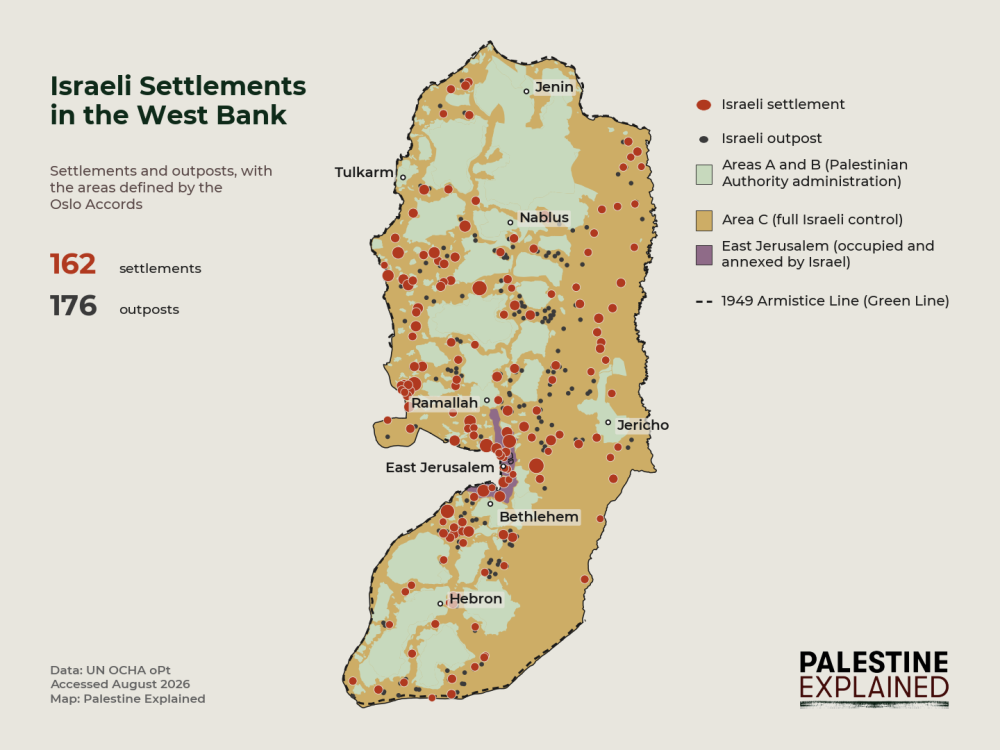
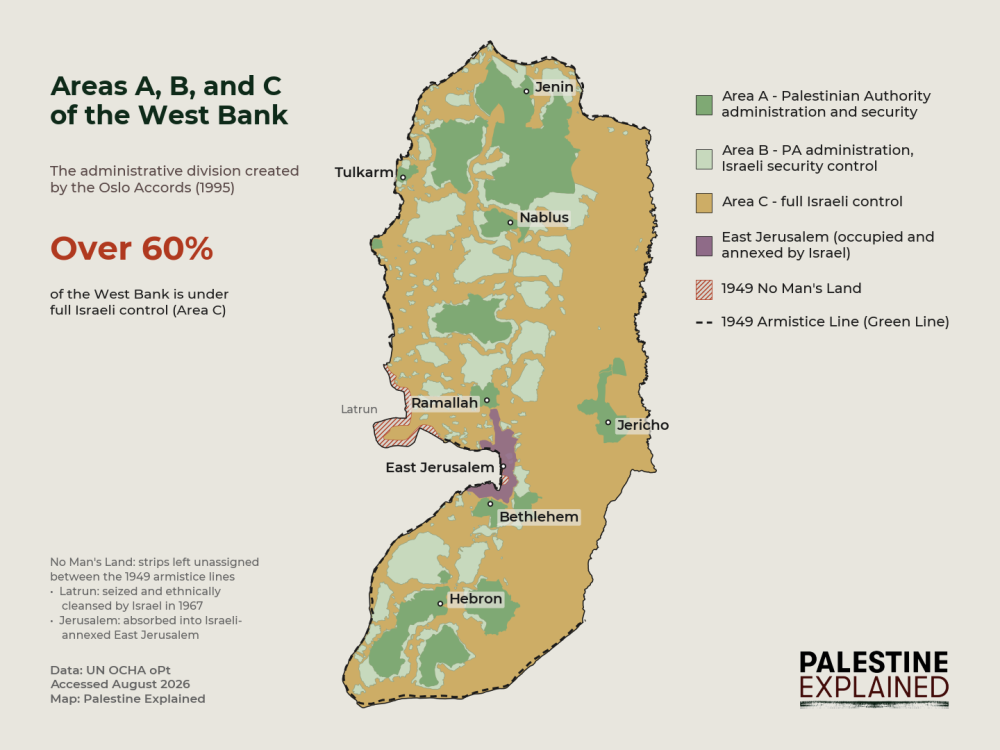
In Brief: The Oslo Accords divided the West Bank into three administrative zones, Areas A, B, and C, which technically correspond to areas under exclusive Palestinian Authority (PA) control (Area A), joint Israeli-Palestinian rule (Area B) , and Israeli control (Area C). In practice, Israel has disregarded this agreement, violated its terms, and continues to expand illegally into Palestinian land.
In More Detail: The Oslo Accords, a series of agreements brokered by the United States between 1993 and 1995 and signed by the Palestine Liberation Organization (PLO) and Israel, led to the establishment of the Palestinian National Authority, otherwise known as the Palestinian Authority (PA).
Under the Oslo II Accord (1995) the West Bank was divided into three areas under differing administrative arrangements:
- Area A: PA security and administrative control, comprising approximately 18 percent of the territory.
- Area B: Joint Israel-PA administration, with Israel in control of security and PA administrative rule, comprising approximately 22 percent of the territory.
- Area C: Exclusive Israeli control, comprising approximately 60 percent of the territory.
Areas A and B are the most densely populated, with 2.8 million Palestinians living between the two areas, although they only constitute approximately 40 percent of West Bank land. Important cities and towns in Areas A and B include Bethlehem, Jenin, Nablus, Ramallah, and most of Hebron. Some cities and towns are divided between two or even three of Areas A, B, and C.
The administrative division was meant to be temporary and coincide with gradual Israeli military withdrawal from occupied lands in the West Bank, ahead of final status negotiations for the so-called “peace plan.” In practice, Israel refused to comply with the terms of the Oslo Accords—relegating the PA role to nominal rule and refusing to withdraw from Area C, as stipulated. Other serious violations include regular launching of military incursions and “security operations” in all areas of the West Bank, regardless of the security designation under Oslo II.
Among the flaws and disparities of the Oslo Accords is that the spatial distribution of Areas A, B, and C is not based on any logical geographic or planning principles. Instead, this division was meant to create large swathes of territory for Israeli settlers with as few Palestinians living there as possible. Effectively, it created isolated, non-contiguous enclaves whose fragmentation makes them structurally unstable, thus rendering Palestinian land vulnerable to incremental territorial erosion at the hands of the Israeli military and settlers.
Israel also uses Area C to internally fragment territories within Areas A and B. In other words, parts of Area A are fragmented from other parts of Area A because portions of Area C cut through and divide the territory. Likewise, parts of Area B are internally fragmented from other parts of Area B for the same reason. Due to Israel’s system of control over Palestinian movement, these territorial divisions and physical restrictions create access barriers for Palestinians moving within and between Areas A-C.
This territorial division ultimately serves as a mechanism for Israeli expansionism and control of the entire area, precluding the ability of Palestinians to freely live in, move on, and develop their land.
Is the division of the West Bank into Areas A, B, and C harmful to Palestinians?
In Brief: The creation of Areas A, B, and C in the West Bank reflects the vast power inequities between Palestinians, as an occupied people, and Israel, as an occupying force. Israel has not fulfilled its commitments under the agreement that divided the West Bank into these areas; instead, it uses them to control the most valuable land, thereby fragmenting Palestinian lands and restricting Palestinian movement and freedoms—all of which emboldens Israel to continue its military occupation and settlement expansion.
In More Detail: Under Israel’s occupation, Palestinians are prohibited from creating transportation infrastructure—roads, railroads, aviation—that connects Palestinian territories with one another and the outside world. The division of the West Bank into Areas A, B, and C has further entrenched this fragmentation, despite nominal PA security-administrative control over Area A and administrative rule over Area B. In fact, each respective Area is not even a contiguous territory. Due to Israel’s separation wall, settlements, Israeli-only roads, and checkpoints, the land inside each area is a mere scattering of 165 disconnected “islands.”
Israel formally controls the largest area of the West Bank, Area C, comprising approximately 60 percent of the territory. Belonging to multiple Palestinian villages and Bedouin communities, it contains the most fertile and resource-rich lands and represents an important segment of the West Bank’s agricultural, economic, and urban development potential. About 300,000 Palestinians live in areas fully or partially under Area C as well as 400,000 settlers, who have established over 230 settlements in this area.
As mentioned above, Israel was required in the Oslo agreements to cede control over Area C and withdraw from West Bank territory. However, through the present day, Israel retains full control over security, civil, and land-management affairs in Area C and uses this control to block Palestinian access to this land and its resources. Throughout Area C, Israel denies building permits to Palestinians, forcing homes and other structures to become dilapidated, thus violating their right to build in line with population growth on their own land. Israel also demolishes buildings constructed without permits. In about 60 percent of Area C, Israel allocates land to Israeli-only roads and infrastructure that connects Israeli settlements to one another; it seizes Palestinian land then designates it as state or survey land, firing zones, nature reserves, or national parks; and it bans or severely restricts Palestinian freedom of movement in designated buffer zones and areas such as the “Seam Zone.”
As of 2026, Israel’s control over Area C is rapidly expanding in even more threatening ways. In May 2025, Israel took full control of the Area C land registry, declaring Palestinian efforts to recognize land ownership through its land registry legally void. In February 2026, the Israeli security cabinet ratified measures to advance expanded land registration and property acquisition in Area C. This move, condemned as “de facto annexation” by over 20 countries, makes it easier for Israeli nationals and foreigners to acquire property in settlements and accelerates territorial conquest, making Palestinian landowners even more vulnerable to dispossession and expulsion. These measures represent Israel’s consolidation of its effective annexation of Area C; in fact, they are part of Israel’s strategy toward annexation of the entire West Bank.
What movement restrictions does Israel impose and how do they impact Palestinians?
In Brief: Israel restricts Palestinian movement through physical obstacles like checkpoints, gates, roadblocks, the 712-kilometer-long separation wall, as well as permit systems. This draconian structure of total control has dangerous and negative impacts on Palestinians, blocking their access to main roads, urban centers, essential services, and their own lands and livelihoods.
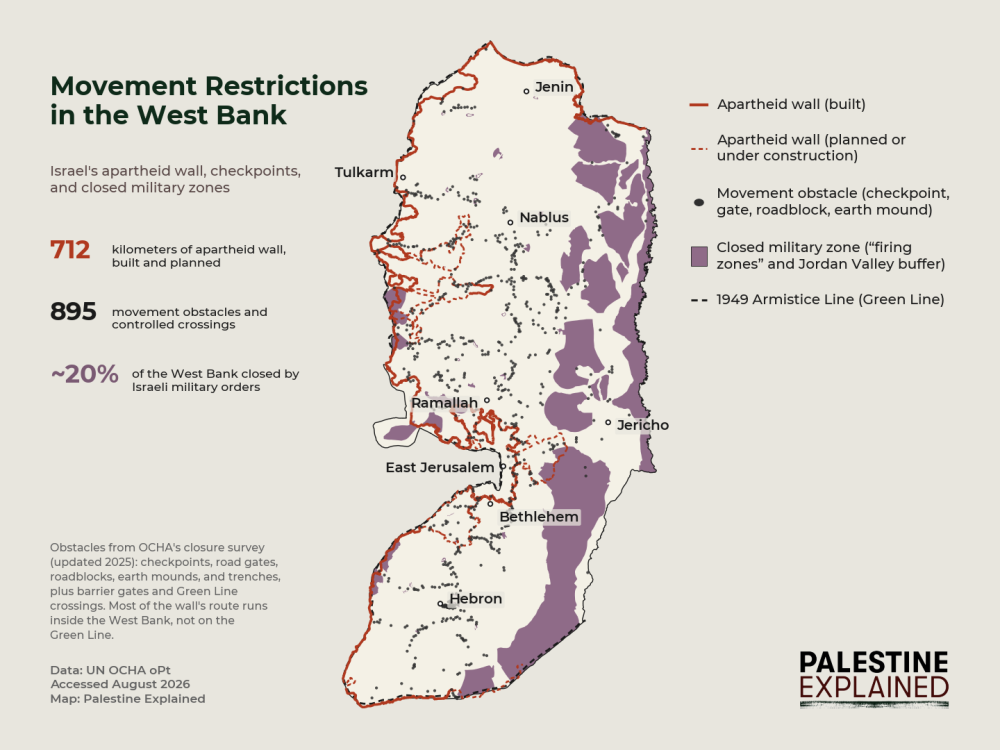
In More Detail: Israeli movement restrictions include hundreds of physical movement obstacles permanently or intermittently controlling, restricting, and monitoring Palestinian movement in the West Bank, including checkpoints, roadblocks, earth-mounds, barriers, trenches, and gates that can be closed at any moment and on an indefinite basis. These obstacles have severe impact on Palestinians by preventing or restricting access and movement to main roads, urban centers, services, and agricultural areas. Forms of movement restrictions include the following:
- Segregated Road Systems: Palestinian traffic is funneled onto longer, secondary road networks as a result of Israel’s movement restrictions. Movement disruptions caused by road closures and Israeli-only road networks force Palestinians to take lengthy detours, at best, or completely block their ability to move for indefinite periods of time, at worst. Settler roads often encircle and fragment Palestinians, as the military prevents Palestinians from approaching the roads—this is an intentional strategy to pressure Palestinians to leave their land. While Israeli settlers enjoy use of a highway infrastructure and road network that easily connects settlements to Israeli territory within the Green Line, Palestinians languish in precarity due to this discriminatory system.
- Road Closures: Israel’s closures of Palestinian roads are unpredictable and can last for days.
- Checkpoints and Roadblocks: There are between 900 and 1,000 Israeli checkpoints or roadblocks in the occupied West Bank. Palestinians are at risk of arrest, violence, humiliation, and even death at checkpoints, where their ability to travel within their homeland is severely restricted and remains at the total discretion of the Israeli military. This causes severe disruptions to daily life and many dangers to Palestinians. Not only is this damaging to labor mobility and disruptive to education, it also can be life threatening for those in need of access to hospitals.
- Israel’s checkpoints have created a dangerous phenomenon in which Palestinian women, under severe distress and blocked from access to hospitals, are forced to undergo labor at checkpoints.
- Apartheid Wall: Israel’s apartheid wall (sometimes referred to as the “separation wall”) is 712 kilometers long, and about 85 percent of this wall runs inside the West Bank. The apartheid wall separates West Bank Palestinians from East Jerusalem and even blocks some residents of villages in the Israeli-annexed Jerusalem municipality from entering Jerusalem, which is a short walk away from their homes. As a result of Israel's apartheid wall, there is an entire generation of Palestinian youth who might never see the sea, as they are completely blocked from the Mediterranean Sea shoreline due to Israel's policies–—just like many Palestinians in Gaza who have never seen the mountains of northern and central historic Palestine.
- Permit Regime: West Bank Palestinians must apply for travel permits from Israel to enter occupied East Jerusalem or to travel abroad. All entry points into and out of the West Bank are controlled by Israel. Even Palestinians in dire need of medical treatment, unavailable in poorly resourced hospitals, are subject to this cruel system. Between January and September 2025, almost 19,000 travel applications were denied or delayed for patients seeking medical treatment in East Jerusalem or Israel—that’s one third of all applicants. This causes the worsening of health conditions and, sometimes, death. In general, all Palestinians in the West Bank lack freedom of movement, impacting all areas of their lives.
- Military or Settlement Restrictions: Israel often restricts Palestinian access to large swathes of West Bank territory that it claims for Israeli military training purposes, or it declares territories as security buffer zones. Restrictions on movement go beyond the physical barriers themselves. Access to 20 percent of the West Bank is prohibited by Israeli military order on the grounds that the area is designated as a “firing zone” for military training, or as a border buffer zone. Military orders bar Palestinians from access to an additional 10 percent of West Bank land falling within the municipal boundaries of Israeli settlements. As a result, many farmers can only reach their private land and property located within or around settlements twice a year at most, subject to approval from Israeli authorities. In total, about 40 percent of the total area of the West Bank is off-limits to Palestinians due to a combination of “security” restrictions by the Israeli military, or to keep dispossessed Palestinians away from stolen West Bank land in Israeli settlements.
What is annexation?
In Brief: Israel has long intended to annex the West Bank or to formally declare its sovereignty over the territory and impose its laws and administration—a move that is illegal under international law. Israel weaponizes laws like the Absentees’ Property Law to seize Palestinian property then formally annexes seized land and blocks Palestinians in the remainder of the occupied territories from freely accessing it. Israel has already annexed East Jerusalem and surrounding areas of the West Bank by expanding its Jerusalem municipality boundaries and then formally approving the annexation through the 1980 Basic Law—which was condemned by the UN Security Council. Though the annexed territories are technically part of the Palestinian Authority (PA) Jerusalem Governorate, in reality the PA does not control most of these areas. Palestinians in annexed areas face severe restrictions on their freedoms, including on their movement and property rights, as well as apartheid conditions, family separation, and the constant threat of dispossession and displacement.
In More Detail: Palestinians are threatened by Israel’s attempts to annex—impose its sovereignty over—the Israeli-occupied West Bank. Annexation is a measure that formalizes (under Israeli law only) Israel’s illegal practices in the West Bank and constitutes a rejection of calls to abide by international law. In 2025, the Knesset passed a non-binding resolution in support of annexing the West Bank, and in 2026, the security cabinet announced measures that will enable land appropriation and settlement expansion—acts widely recognized as facilitating its goal of annexation.
Parts of the West Bank are already annexed. Indeed, after imposing its occupation over the West Bank and East Jerusalem, Israel extended the boundaries of its Jerusalem municipality (over 70 square kilometers), annexing occupied East Jerusalem and surrounding areas of the West Bank. Israel moved from de facto to de jure annexation in 1980, when the Knesset approved a Basic Law annexing the territory—an act condemned in UN Security Council Resolution 476.
The dangers of annexation are apparent through examination of Israel’s practices in East Jerusalem and the surrounding territory after the 1980 annexation law passed: Israel instrumentalized the Absentees’ Property Law (1950) to seize the property of ethnically cleansed Palestinians. According to this Israeli-promulgated broad term, an “absentee” is a displaced Palestinian who was ethnically cleansed to Arab states or other parts of historic Palestine that became the occupied Palestinian territories. In the 1970s, a series of amendments to the 1950 law facilitated Israeli settlement and Palestinian displacement and dispossession. First, the definition of “absentee” was expanded to the property of Palestinians who lived in Jerusalem but owned property within the new municipal boundaries. Second, when Israel purchased absentee property through coercion (where its owner refused to sell or did not respond to their offer within Israel's designated timeframe), the state retained these funds. Third, following the 1980 annexation law, Israel allowed state agencies to formally acquire ownership over this “absentee” property.
Following the formal annexation of East Jerusalem and its surrounding areas, Palestinians in the remainder of the occupied West Bank and Gaza Strip were blocked from free access to the annexed territory, meaning that Palestinians now required permits to visit this part of their homeland, including Jerusalem. Among the many consequences of this change is the impediment to Palestinian freedom of worship: Palestinian Muslims were now blocked from free access to the Aqsa Mosque (the third holiest site in Islam) and the Dome of the Rock, and Palestinian Christians were cut off from free access to churches and pilgrimage sites such as the Church of the Holy Sepulcher and the Via Dolorosa. In other words, for example, a Palestinian Christian from Bethlehem, the birthplace of Jesus Christ, does not have freedom of worship in the birthplace of Christianity.
The East Jerusalem and West Bank areas annexed by Israel are technically part of the Palestinian Authority (PA) Jerusalem Governorate, although the PA does not control most of these areas. The Jerusalem Governorate is about 345 square kilometers, including areas in the West Bank outside of the annexation boundaries. The term J1 refers to the Israeli-annexed areas and J2 refers to the remainder of the West Bank portion of the Jerusalem Governorate (it is important to note that the vast majority of J2 territory falls in Area C of the West Bank, which is under total Israeli control).
Palestinians living under Israeli annexation in the Jerusalem municipality face severe restrictions on their overall freedoms, including movement and property rights, and contend with the constant threat of dispossession and displacement, as follows:
- Statelessness: Despite Israel’s declaration of sovereignty over their land, Palestinians in this area are not Israeli citizens. Instead, Israel imposes a rigid permit regime on Palestinians.
- Jerusalem Residency, Precarity: Residents of East Jerusalem must have “permanent resident” status and carry a blue ID card to live “legally” in the city; however, Israel can revoke this status at any time for any reason, which is a first step toward Israel’s illegal seizure of Palestinian property. Israel often deems Palestinians, whose families span many generations in the city, to be “illegal residents” in order to build settlements and seize their property.
- West Bank Residency, Precarity: Palestinians living in West Bank areas annexed to Israel’s Jerusalem municipality carry a mix of Jerusalem “permanent resident” ID cards and green PA-issued cards. The specific ID card a Palestinian holds is not a matter of choice for them; Israel has the final word on what IDs were distributed to each Palestinian locality. However, at any point, Israel can decree that Palestinians under Israel's Jerusalem municipality in the West Bank are carrying the “wrong” IDs, and as such, they run the risk of being ethnically cleansed at any time.[13]
- Travel Restrictions: If Israel deems that a Palestinian’s “center of life” has moved outside of Jerusalem, it can revoke their permanent residency status. If a Palestinian travels abroad for an extended period of time or acquires permanent residency or citizenship abroad, their residency status can be revoked—even though Israel allows dual citizenship for its own nationals. This also applies to the West Bank, meaning that Israel can revoke the status of East Jerusalem Palestinians who choose to reside in the West.[14]
- Family Separation: Not only did family networks cut across these artificial municipal boundaries before Israel’s occupation, family networks existed between various points of historic Palestine with one another and with parts of neighboring Arab countries before the Nakba as well. Today, if a Jerusalem ID holder marries a West Bank ID holder, they cannot live together in Jerusalem. This makes it virtually impossible for the children of a mixed-status couple to obtain Jerusalem IDs with both parents living in the same household, as the Jerusalem-resident parent’s “center of life” must be in the city—something rendered impossible by the permit regime.
- Statusless Children: As a result of these policies, many Palestinian children in Jerusalem lack residency status. This blocks them from receiving health benefits, makes school registration difficult or impossible, and severely limits their movement within and outside of the city.
- Apartheid Conditions: Occupied East Jerusalem is surrounded by Israel’s apartheid wall, which separates it from the West Bank and vice versa. It even closes off villages within the Israeli-annexed Jerusalem municipality from East Jerusalem proper. In an attempt to push Palestinians out of Jerusalem, Israel imposed strict residency requirements
The convoluted nature of Israel’s permit regime might appear tedious or perplexing, but it masks the cruel reality imposed on Palestinians. It is clear, when looking at the profound harm caused to Palestinians of Jerusalem and parts of the West Bank annexed by Israel, there are serious dangers that await the remainder of West Bank Palestinians as a result of Israel’s drive to annex the entire territory.
What is the scale of Israel’s settlement enterprise?
In Brief: Israeli settlements in the West Bank displace, dispossess, fragment, and deny Palestinians access to their own land and resources while subjecting them to settler violence. Settlers have seized over 40 percent of West Bank land, with 147 official settlements and 224 unofficial settlement outposts in the territory. Often armed, settlers use violence to displace Palestinians, including beating and killing them, destroying their homes, trees, and fields, and stealing their cattle and crops. The Israeli military enables and sometimes takes part in this violence.
In More Detail: Over 40 percent of West Bank land has been seized by Israeli settlers. Between 1967 and 2024, Israel demolished 59,824 homes of Palestinians in the West Bank and East Jerusalem, the majority of which were razed to clear land for use by the Israeli military. As of 2025, the West Bank is impacted by the following:
- 147 Israeli settlements.
- 224 settlement outposts.
- 60 outposts retroactively legalized since 1991, either as an officially recognized settlement, a neighborhood added to nearby settlements, a tourist site, an educational institution, or a farm.
- 503,732 settlers.
- 60,000 settlers are American-Israeli dual citizens, or 15 percent of all settlers.
- About 15 percent of the West Bank population are settlers, who control over 40 percent of the land.
- Palestinians are 85 percent of the population, over 3 million people, who are denied access to nearly half of the territory they live in.
- Millions of dollars each year in donations are collected by tax-exempt charities in the United States for Israeli settlements. While it is difficult to find precise data by year, the following has been reported:
- $220 million in tax-exempt dollars for settlements between 2009 and 2013.
- $2 million tax-exempt dollars raised in the final months of 2023 by the One Israel Fund, based in New York, to provide Israeli settlements with surveillance drones and cameras.
- $5.3 million in donations raised in late 2023 on the Israeli crowdfunding platform IsraelGives, which is registered in New York. Fundraisers provided the Israeli military with equipment for its genocidal war on Gaza and supported Israeli paramilitary squads in West Bank settlements. Many donors to the 450+ campaigns on IsraelGives are in the United States.
- A campaign for the Ma’on settlement outpost’s “security team” received donations from Florida, Illinois, New York, and Pennsylvania.[15] Ma’on settlers are notorious for harassing Palestinians of the South Hebron Hills, including the villages of Tuba and At-Tuwani, routinely attacking children on their daily walk to-and-from school.
- At the time of this fundraiser, a leader of settler attacks from the Ma’on outpost was sanctioned by the US Department of Treasury’s Office of Foreign Assets Control (OFAC). In cases like this, Israeli organizations benefit from tax-exempt donations from Americans to financially sponsor violations of international law and US law.
- At the time of this fundraiser, a leader of settler attacks from the Ma’on outpost was sanctioned by the US Department of Treasury’s Office of Foreign Assets Control (OFAC). In cases like this, Israeli organizations benefit from tax-exempt donations from Americans to financially sponsor violations of international law and US law.
- A campaign for the Ma’on settlement outpost’s “security team” received donations from Florida, Illinois, New York, and Pennsylvania.[15] Ma’on settlers are notorious for harassing Palestinians of the South Hebron Hills, including the villages of Tuba and At-Tuwani, routinely attacking children on their daily walk to-and-from school.
What does settler violence look like and how does it impact Palestinians?
In Brief: Settlers, usually armed, engage in violent harassment, including beatings and sometimes escalating to killings, and inflict severe property destruction to compel Palestinians to leave their land.
In More Detail: Settlers physically assault defenseless Palestinians in the West Bank to intimidate and compel them to leave their homes. This violence includes beatings and sometimes escalates to killing Palestinians by live fire or other methods. Settlers also engage in property destruction and theft, such as destroying trees and crops, torching fields, stealing crops and livestock, sabotaging water infrastructure, damaging homes, cars, and businesses, and blocking roads (even to ambulances and emergency response vehicles). Over 5,350 violent settler incidents were recorded by ACLED (Armed Conflict Location & Event Data project) in the West Bank from 2016 to 2024, while the UN recorded 1,420 incidents of settler violence in 2024 alone.
Israeli authorities enable and sometimes actively participate in settler violence. As a matter of policy, the Israeli military does not confront violent settlers and often merely observes settler mob attacks on Palestinians as they unfold. Further, the Israeli military facilitates the objective of settlement expansion by imposing closed military zone orders on Palestinians—restricting their movement or by firing stun grenades, tear gas, rubber-coated metal bullets, and even live rounds on Palestinians.
Collusion between the Israeli military and settlers has escalated to providing arms. Before October 2023, at least 2,600 military weapons were issued by the Israeli military for “settlement emergency squads,” which are militias trained and authorized to use force and perform policing tasks like searches and arrests. Since October 7, the army has distributed thousands more weapons and munitions. The scale is significant: due to a push from National Security Minister Itamar Ben-Gvir, Israel eased requirements for Jewish Israelis to acquire gun licenses, approving 165,000 permanent licenses by June 2025, with many arms distributed to settler militias.
Since October 7, settler violence in the West Bank has dramatically increased. From October 2023 through November 2025, Israeli security forces and settlers have killed at least 1,017 Palestinians in the occupied West Bank, including 221 children. These figures do not include Palestinians who died in Israeli prisons, where Palestinians, many of whom are administrative detainees held without charge, are subjected to inhumane treatment and torture, including sexual assault, denial of medical treatment, and other abuses. Over 20,000 West Bank Palestinians were detained in the first two years of Israel’s genocidal war on Gaza—and among these detainees were 1,600 children.
In late 2025, a spike in Israeli military raids and settler violence across the West Bank drove new displacement, shut schools, and disrupted essential services for tens of thousands of Palestinians. By December 2025, there were 1,680 settler attacks across more than 270 communities. At an average rate of five settler attacks per day, settler violence disrupted the olive harvest season, which many Palestinians depend on, with widespread assaults on farmers, trees, and agricultural infrastructure. Masked gangs of settlers armed with bats and Molotov cocktails raided West Bank streets, smashed and set fire to cars, homes, olive groves, and churches, and beat and killed Palestinians.
According to a report by the UN High Commissioner for Human Rights, settler attacks and Israeli policies led to the displacement of 1,615 Palestinians in the West Bank, affecting 828 children, in the period between November 2024 and October 2025. Noting the forced displacement of 32,000 in Israel’s January 2025 military assault on the El-Far`a, Jenin, Nur Shams, and Tulkarem refugee camps and their surroundings in the northern West Bank, the report stated that settler-and-military-provoked displacements constitute an attempt by the state of Israel to “consolidate its unlawful annexation of large parts of the occupied territory and the forcible transfer of Palestinians.”