What is the Nakba?
In Brief: The Nakba refers to the 1948 mass expulsion of Palestinians, understood as an ongoing process of displacement and dispossession that began with the forced removal of up to one million people and continues through Israeli expansion, settlement, and repeated waves of ethnic cleansing.
In More Detail: The Nakba, or catastrophe in Arabic, refers to the mass expulsion of Palestinians in 1948, which set the stage for their continued ethnic cleansing, displacement, and dispossession. A total of 750,000 to one million Palestinians were forcibly removed from their homes and lands by Zionist militias, which immediately became the foundation of the Israeli military during the Arab-Israeli War of 1948. While Palestinians mourned the loss of their homeland as a result of this war, the state of Israel celebrates it as their war of independence.
Forced to march by foot or to flee using boats, some Palestinian refugees sought refuge in neighboring Arab countries and others became internally displaced. Jordan, Lebanon, and Syria received hundreds of thousands of Palestinian refugees, many of whom lived in United Nations Relief and Works Agency for Palestine Refugees (UNRWA) camps, and where many of their descendants still live today. Internally displaced Palestinians fled to other parts of historic Palestine. Over 200,000 refugees fled to the Gaza Strip and about 280,000 fled to the West Bank, while some sought refuge in other areas of historic Palestine, eventually becoming citizens of Israel.
Palestinians refer to the Nakba as an ongoing process due to Israel’s expansionism and forced expulsions. For example, Israel ethnically cleansed an additional 300,000-400,000 Palestinians during the June 1967 war, known to Arabs and Palestinians as the Naksa, or “setback.” Through its ongoing settlement expansion, Israel has continued the displacement and dispossession of Palestinians. As a result of Israel’s genocidal war on Gaza, nearly all of the territory’s residents are internally displaced, with about 100,000 Palestinians having fled Gaza altogether.
What was life like in Palestine prior to the Nakba?
In Brief: Before the Nakba, Palestine was a vibrant, historically rich society marked by thriving agriculture, growing literacy, active print culture, bustling port cities and trade hubs, robust religious and educational institutions, and a population that was increasingly politically engaged.
In More Detail: Historically, Palestine was a land situated at the crossroads of empires, regional trade routes, and continents, connecting southwest Asia with the African continent. As a regional trade hub, with holy sites revered in the Abrahamic religions and home to prominent cities connecting the Mediterranean coast with the Levantine heartland, Palestine was an important site for cultural exchanges, religious pilgrimage, education, and trade.[1] With its strategic location, fertile soil, and ancient cities, Palestine was a continuously populated land sought after by empires since the ancient period.[2] In 1516, Palestine was conquered by the Ottoman Empire and remained under Ottoman rule until the British Empire conquered Palestine in December 1917 during World War I (1914-1918), eventually causing the collapse of the Ottoman Empire.
To understand the difficult changes imposed by the Nakba, it is important to understand some aspects of daily life in Palestine during the late Ottoman era and the subsequent period of British colonial rule.
In the earliest years of the twentieth century, Palestine was largely an agrarian society. Many peasants engaged in a farming system on tracts of land owned collectively, where farmers took turns cultivating different pieces of land so that all members would have periodic access to the most fertile areas.[3] While the majority of society was agrarian, it is important to note that Palestinian peasants were not homogeneous; they occupied different class strata—with some groups playing a key role in regional trade links—and navigated sometimes complex relations with local and imperial authorities, as historian Beshara Doumani explained in his study of Ottoman Nablus.[4] Major staples cultivated and produced in Palestine included barley, olives and olive products, oranges, and wheat.
Palestine witnessed a boom in its literacy rate in the first half of the twentieth century. Literacy rates throughout the region were increasing during this period, with Palestinians quickly catching up to their counterparts. Over time, literacy was understood to be an essential tool for Palestinians to defend themselves in the face of the collapse of the Ottoman Empire, the violence of British colonial rule, and the threat of Zionist settlement aimed at creating an exclusionary state in Palestine. In fact, some rural villages volunteered to help fund the cost of establishing modern schools to aid in this shared commitment to increasing the literacy rate, noting the British colonial government’s slow pace in expanding schools for Palestinian communities.[5]
Palestine encompassed several major cities and towns. Along the coast, Acre, Haifa, Gaza City, and Jaffa connected Palestine to other important cities of the Eastern Mediterranean and were key centers of publishing, trade, and culture. Jerusalem arguably held the most significant status, with Palestinians taking pride in their proximity to the city they described with honorifics such as Bayt al-Maqdis (House of Sanctity) and Al-Quds al-Sharif (The Noble Holy Place).[6] Nablus, an interior city, was a historic trade hub connecting crops and agricultural products from Palestine’s rural hinterland to major cities in the region, including Cairo and Damascus.
Nazareth, the home of Jesus Christ located in the northern region of Galilee, holds an important place in Christian tradition and is home to churches revered for their role in important biblical events, including the Greek Orthodox Church of the Annunciation, the Roman Catholic Basilica of the Annunciation, the Mensa Christi Church, and the Synagogue Church. In central Palestine, the city of Ramla was a site of religious learning and home to Shaykh Khayr al-Din al Ramli (1585-1671 CE), a renowned scholar of the Hanafi school of Islamic jurisprudence.[7] Other historic towns include Tiberias, Beersheba, and Safad.
Along with the boom in literacy rates, the education rate also rose steadily in the late Ottoman period due to the wider availability of public schools and the growth of private educational institutions. As a result of these transformations, Palestine saw two important developments: the rise in local print culture and the growth of the professional class. Major newspapers established in the final years of Ottoman rule through the British Mandate period, and their places of publication, included: al-Difa` (Jaffa), Filastin (Jaffa), al-Karmil (Haifa), and Mir’at al-Sharq (Jerusalem). Palestine also witnessed the growth of literary, cultural, and scientific magazines in the final decades before the Nakba.
With the circulation of publications published in Palestine as well as major publications from cities like Cairo, Beirut, and Alexandria, coupled with the rise of the professional class, political discourse expanded throughout the country, helping to feed the growth of political movements and organizations. Some Palestinian leaders gained political experience as elected members of the short-lived Ottoman parliament (1876-1878), which had representatives from throughout its provinces or as bureaucrats in the Ottoman administration in Palestine. Over time, especially following the collapse of the Ottoman Empire and the imposition of British colonial rule, Palestinians drew from these experiences (and others, to be discussed later) to inform their demands for independence and self-determination, just like the rest of the region which fell under British or French rule.
How did World War I set Palestine on the path toward the Nakba?
In Brief: World War I set Palestine on the path toward the Nakba because Britain’s wartime deals, broken promises, violent conquest, and later Mandate policies enabled Zionist settlement, denied Palestinian self-determination, and created the political conditions that led to mass displacement in 1948.
In More Detail: Britain sealed Palestine’s fate before it had conquered the territory, setting its people on a course of death and destruction that would reach a peak in the 1948 Nakba. In the midst of World War I (1914-1918), Britain and France planned for the removal of the Ottoman Empire from its Arab provinces. In a secret agreement known as Sykes-Picot (1916), Britain and France divided the territories between themselves, creating, in broad outline, the map of the modern Middle East that we know today.
Meanwhile, Britain made two, mutually exclusive promises to two groups, each conflicting with British and French plans to control the region following the war’s end. First, in a series of communications known as the Hussein-McMahon Correspondence (1915-1916), Britain promised a prominent Arab leader in the Arabian Peninsula, Sharif Hussein of Mecca, an Arab state, which was understood by the leader to include Palestine, in exchange for his support in rallying an Arab rebellion against the Ottoman leadership. Second, Britain promised a “Jewish national homeland” in Palestine to Zionist leaders in Britain through a communication known as the Balfour Declaration (1917).
If avenues for self-determination were precluded prior to Britain’s military takeover in Palestine, the physical arrival of the British in the territory made matters even worse for Palestinians. Britain’s campaign to conquer Palestine and Jerusalem began in March 1917, first in Rafah, then Khan Younis, then Gaza City. Ottoman defenses were fierce; the British anticipated a swift victory and path to Jerusalem, but resistance in Gaza City was so strong that it evaded surrender until November 1917, and eventually Jerusalem was occupied in December 1917.
Gaza City was utterly decimated by the British campaign. In addition to artillery bombardment, new military technology enabled the British military to launch air raids on Gaza City, terrorizing the local population, with many fleeing their homes until the campaign ended, and many returning to find their homes, and much of Gaza City, in total ruin. On December 11, 1917, General Edmund Allenby entered Jerusalem and declared martial law. Palestine was placed under the Occupied Enemy Territory Administration (OETA), a system of joint British-French military rule over recently conquered Ottoman territories in the Levant.[8]
After the war, Allied powers set up mandates over former Ottoman territories. Effectively, this system formalized the secret Sykes-Picot agreement, but with a caveat: Amid the US emphasis on self-determination following US President Woodrow Wilson’s Fourteen Points address (1918), delivered in the final months of the war, Britain and France presented their control over the region as temporary tutelage, rather than formal colonialism. By declaring these territories “mandates,” Britain and France declared that they were preparing the peoples living under this system for eventual self-determination and independence.
The British Mandate for Palestine was established in 1920, but it was clear from the outset that Britain had no intention of relinquishing control or ceding room for Palestinians to transition to independence and statehood. Further, the language of the Balfour Declaration was incorporated into the Palestine Mandate submitted by Britain to the League of Nations. The result was formal British recognition of and cooperation with the Jewish Agency—the governing body of the Jewish community in Palestine prior to Israel’s establishment, headed by Zionist leaders—and this was enshrined in the British Mandate for Palestine, affirming its commitment to facilitating Jewish immigration to Palestine, which British authorities understood to be linked to the Zionist project. Overall, Britain’s violent entry to Palestine, callous destruction of Palestinian homes and lives, and suppression of Palestinian independence would be the rule, not the exception, which eventually created the conditions for the Nakba.
How did Britain create asymmetries in Palestine that enabled the Nakba?
In Brief: Britain enabled the Nakba by denying Palestinians the rights and institutions needed for self-determination while empowering the Zionist movement with political support, economic advantages, and freedom to build parallel institutions, creating a profound asymmetry that left Palestinians vulnerable to eventual displacement.
In More Detail: In order to understand the severe difficulties that British colonial rule brought to Palestinians, it is important to note two key transformations—one internal and one global:
- Internal: In the final years of Ottoman rule, modernization and legal reforms changed the empire’s relationship with its subjects and provinces. During this period, the Ottoman Empire increasingly treated its subjects as modern citizens rather than imperial subjects. For the first time, regardless of faith—whether Muslim, Christian, or Jewish—they were expected to serve the state; in return, they were granted expanded rights, including constitutional protections in theory and, for a brief time, representation in parliament. Despite the parliament’s short life span, and the unpopular extension of military conscription, the idea of modern citizenship nonetheless took root in Palestinian society, as it did in many other provinces of the Ottoman Empire, joining a conversation that expanded far beyond the Ottoman domain. Muslims, Christians, and Jews in late Ottoman Palestine generally embraced the notions of Ottoman belonging and modern citizenship, as discussed in historical scholarship on this period.[9] When the British Empire expanded into Palestine under the British Mandate, its rhetoric disguised the true nature of its power and aims. Although officials referred to Palestinians as “citizens,” they were governed as colonial subjects, which Palestinians resisted and the British brutally enforced.
- Global: In the nineteenth and early twentieth centuries, nationalist movements across regions and within empires demanded independence, modern nation-states, representative governments, citizenship, and self-determination. Palestinians were no exception: these ideas had already taken root and spread through a growing Palestinian press and other channels, fueling demands to move beyond subjecthood imposed by foreign imperial rule.
As Palestinians grew frustrated with the pressures of British Mandate rule, they also observed a troubling asymmetry. The Zionist movement—which sought an exclusive Jewish state in Palestine and had gained British support through the 1917 Balfour Declaration as well as recognition in the British Mandate (link to question 3)—was mobilizing Jews worldwide to settle in Palestine with the explicit goal of creating a Jewish majority. The goal of the Zionist movement was to engineer a demographic majority and purchase as much land as possible in Palestine to make that exclusivist state a reality. It is important to note that British policy toward Zionist demands shifted over time, with colonial authorities enabling the Zionist movement increasingly as their rule was about to end. The general pattern, however, was that Britain granted autonomy, economic opportunity, and privileges to Jews that were systematically denied to Palestinians.
To constrain Palestinian nationalism, the British used divide-and-rule tactics they had employed in other colonies to prevent the rise of organized Palestinian nationalist expression. In 1921, British authorities centralized the activities of the ulama (Muslim religious scholars) and the management of religious endowments (awqaf) under a new body, the Supreme Muslim Council. To this end, they appointed a young Jerusalemite, Hajj Amin al-Husseini, to a newly invented post, the Grand Mufti of Jerusalem, to lead the Supreme Muslim Council (SMC). This centralization, unprecedented in Palestine, placed religious authority under a British-created institution that could be managed and controlled by colonial authorities. More specifically, the SMC was created as a counterweight to emerging expressions of Palestinian nationalism, such as the Palestinian National Congress (or Palestinian Arab Congress), which grew out of activism by Muslim-Christian associations throughout Palestine that mobilized the masses and lobbied for independence. The Palestinian National Congress demanded self-determination and representative government. Although it evolved to take the form of Palestinian nationalist expression, it was subverted by divide-and-rule tactics and blunt repression, policies that were also confronted by nationalist mobilizations later on (see question 5).
Whereas Zionist settlements were allowed to operate and publish newspapers, run their own schools and curricula, and receive trade concessions that enabled infrastructure and business development (ultimately forming the basis of the Israeli economy), Palestinians were denied these same rights. Despite repeated efforts to secure a free press, shape their education system, and gain economic opportunities, the Palestinians’ demands were consistently blocked by Mandate authorities.[10] Such asymmetry resulted in one defenseless population that was systematically denied the opportunity to build institutions to prepare for independence and statehood versus a heavily armed settler-colonial movement with advanced institutions—and a plan to establish a majority by force and mass expulsion of the indigenous Palestinian population.
How did British security policy—particularly during and after the Arab Uprising of 1936-39—create the conditions for mass expulsion?
In Brief: British security policy during and after the 1936-39 Arab Uprising crushed Palestinian nationalist leadership through mass killings, imprisonment, exile, and disarmament while simultaneously arming and training Zionist militias, creating the military and political asymmetry that enabled large-scale expulsions in 1947-48.
In More Detail: Penalties imposed on Palestinians for violating British laws were far harsher than those imposed on Jewish settlements, especially during the 1936-39 revolt, including collective punishment, house demolitions, curfews, and administrative detention. [11] The Arab Uprising of 1936-39 was a mass movement demanding independence, statehood, and an end to colonial domination. It protested the threat of Zionist settler colonialism at the expense of the Palestinian majority.
The uprising entailed strikes, demonstrations, and armed rebellion, including a months-long general strike.[12] The initial strike, which lasted six months, saw Palestinians shut down ports and ground transportation, boycotts, and the refusal to pay taxes. Palestinians invoked the principle of self-determination that the postwar mandate system claimed to uphold. The British response to the Palestinian uprising echoed methods used elsewhere in the empire, including Kenya and India, relying on emergency laws and collective punishment to crush resistance brutally.
In total, British forces, at times assisted by Zionist auxiliaries, killed about 5,000 Palestinians, wounded roughly 10,000, and arrested more than 5,600. Estimates suggest up to 10 percent of adult Palestinian men were killed, wounded, jailed, or forcibly exiled during the three years.[13]
Exile was a favored tactic across the empire. Palestinian leaders were often exiled to the Seychelles, just as their counterparts in Egypt were exiled to Malta by the British for nationalist protest. Meanwhile, the British response to Zionist underground activity was often milder and uneven, with punishments inconsistently applied. In many cases, authorities looked the other way as Zionist paramilitaries armed themselves and violated Mandate regulations.
British authorities also funded and trained auxiliaries such as the Jewish Supernumerary Police “Notrim” and its Jewish Settlement Police, who were used to crush Palestinian rebellion and nationalist protest. Zionist paramilitary activity involved the Haganah as well as underground groups such as the Irgun (also known by the acronym “Etzel”) and Lehi (or “Stern Gang”). During World War II, British cooperation helped form the Palmach in 1941, creating elite cadres that later waged major ethnic cleansing campaigns against Palestinians. For the British, the unintended consequence of collusion with and arming of the Zionist movement was a wave of terror attacks, the most infamous of which occurred on July 22, 1946, when the Irgun bombed the King David Hotel in Jerusalem, home to the British Mandate civilian administration, killing 91 people.
One of the most consequential forms of enablement was the use of collective punishment to suppress Palestinian nationalist activity. British officer Orde Wingate formed Special Night Squads in 1938 with Haganah participation, providing training and conducting joint operations. Wingate’s units were trained to conduct night raids, ambushes, and what the British officer called “retaliatory operations” against villages suspected of aiding rebels.[14] In this sense, British training, arming, and legal frameworks materially enabled Zionist military capacity, which was later used in 1947 to 1948.
The net result was twofold: the Zionist movement gained arms and combat experience under British auspices, while Palestinians were progressively disarmed through arms searches, licensing, and the Defence (Emergency) Regulations of 1945—a brutal system of martial law that Israel drew upon following its occupation of East Jerusalem, the Gaza Strip, and the West Bank in 1967—leaving Palestinians severely exposed as Zionist paramilitaries prepared for mass expulsions.
What did Palestinians do to prevent and resist the Nakba?
In Brief: Palestinians resisted the Nakba through political organizing, diplomacy, protests, strikes, journalism, and local defense efforts, but their attempts to protect their communities and block partition were overwhelmed by British-imposed disarmament and the far superior military strength of Zionist forces.
In More Detail: As the Zionist threat grew, especially in the final decade of British rule, Palestinians defended their communities, demanded independence, and warned of the dangers of Zionist settler colonialism. In the immediate leadup to the 1948 war and mass expulsions, the prevailing mood was fear and a sense of impending disaster.
Through political organizations such as the Palestine National Congress (Palestine Arab Congress), the Islamic Congress, the Arab Students’ Congress, and the Istiqlal Party (istiqlal is Arabic for “independence”), Palestinians identified the settler-colonial threat and demanded decolonization and self-determination. Palestinians also engaged with leaders of other anti-colonial movements to seek support and to chart a path that could preempt further harm from British colonialism and Zionist settler colonialism.[15] In the national, regional, and international presses, Palestinians published articles opposing the Zionist project, arguing for Palestinian statehood, and appealing for international support. Palestinians organized protests, strikes, and at times armed resistance, most prominently in the Arab Uprising of 1936–39 (link to question 5).
Palestinians were effectively disarmed as a result of the British crackdown on the 1936-39 uprising, leaving them virtually defenseless in the final years before the termination of the British Mandate in 1948. Despite tight controls, Palestinians attempted to arm and defend themselves in small numbers, at great personal risk, due to the iron-fisted British response to any Palestinians carrying weapons. Defense preparation occurred on the individual and community levels, with some villages raising funds and selling personal belongings to arm local defense initiatives and form resistance units. However, these defense preparations were sparse and, in most cases, paled in comparison to Zionist offensive capabilities.
In February 1947, Britain announced plans to withdraw from Palestine and referred the question of Palestine to the newly formed United Nations. Despite the Allied victory in World War II, Britain faced severe strain in the aftermath of the war. A new Labour government, headed by Prime Minister Clement Atlee, sought to relinquish some imperial domains to focus on building out Britain’s social welfare system. The United Nations Special Committee on Palestine (UNSCOP) was tasked with deciding the fate of Palestine following the termination of the British Mandate. The eleven-member body had little to no expertise on Palestine and ultimately drew up the UN Partition Plan, enshrined in UN General Assembly Resolution 181, which called for a Jewish state on 56 percent of Palestine and an Arab state on 44 percent, tied to one another under an economic federation, with international administration over Jerusalem. While Palestinians were the majority of the population, with about 1.3 million (2/3 majority), they were granted a state on only 44 percent of the land. The Jewish population was about 600,000 (a 1/3 minority) and the Jewish state would be on 56 percent of Palestine; it would also have control of 40 percent of Palestinian villages and the most fertile agricultural land.[16] Despite efforts of the Zionist movement to purchase land for decades, Jewish landownership only accounted for 6 percent of land in all of Palestine as of 1947, but this plan handed over a majority of land to a minority of the population.[17]
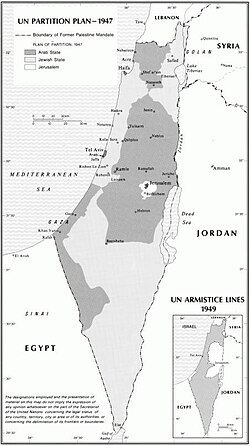
When UN General Assembly Resolution 181 passed on November 29, 1947, Palestinians rejected the plan and protested the unjust division of land. Zionist leadership claimed to accept the plan, but only because Arab states and Palestinians publicly rejected it—they discussed a strategy of publicly accepting the plan while privately working to undermine its provisions.[18] Privately, David Ben Gurion and other key Zionist leaders acknowledged this was merely a step toward the ultimate goal of acquiring all land between the river and the sea; this plan was evident by the immediate implementation of ethnic cleansing campaigns in December 1947 to gain land by force (see question 7).[19]
In response to the plan, Palestinians protested. They began to join more organized forms of resistance, such as the Holy War Army, under the umbrella of the Arab Higher Committee and commanded by Abd al-Qadir al-Husseini. Others volunteered to fight alongside the volunteers from Arab states, who were sent to defend areas designated for a future Arab state under UN Resolution 181. Resistance efforts included attempting to block Zionist paramilitary access to roads, protecting civilians, defending towns and villages, and blocking Zionist takeover of Palestinian lands. As early Zionist paramilitary attacks on Palestinian communities escalated in early 1948, local committees carried out night watches, prepared defenses, and created safe passage routes for civilians.
Perhaps the bravest act of resistance was the refusal of many Palestinians—entire communities in some cases—to leave their homes, even as tanks advanced and leaflets warned them to flee or face death. Some held out for weeks under heavy Zionist (and later official Israeli) military bombardment. Others were forced out of their homes by the barrel of a gun, while many were shot and killed while returning to their homes to salvage personal possessions or crops.
Despite disarmament and scarce resources, Palestinians advocated for their cause and resisted through the press, diplomacy and petitions, mass protest, and local defense. They organized strikes and boycotts, rebuilt committees, raised funds, and mobilized volunteers to block partition and protect communities. These actions could not overcome the military and institutional advantages built up by Zionists under the British Mandate, but they constitute a record of sustained, organized refusal by Palestinians to relinquish their land or political rights.
How were Palestinians removed from their land in the Nakba?
In Brief: Zionist forces expelled Palestinians through a coordinated campaign of massacres, terror, and destruction outlined in Plan Dalet, which used violence, intimidation, and systematic attacks on towns and villages to ethnically cleanse over 750,000 Palestinians and erase hundreds of communities.
In More Detail: Zionist forces used a combination of the following tactics to ethnically cleanse Palestine: massacres, sexual assault, propaganda and threats, sniper attacks, artillery shelling, airstrikes, and even biological warfare.[20] As a result of these threats, all of the one million Palestinians dispossessed as a result of the Nakba fled their homes and land under duress.
The ethnic cleansing of Palestinians was not an accident of war; rather, it was an intentional outcome of a methodical, meticulously researched, and premeditated plan concocted by Zionist leadership, called Plan Dalet, or Plan D. Ideas surrounding population transfer are as old as the Zionist movement and the first wave of Zionist organized settlement in Palestine (which began in 1882), and gave way to detailed research and planning in the 1930s and onward.[21] These ideas intensified in the final years of British rule, pushing Zionist leaders to view the mass expulsion of Palestinians as inevitable. The Jewish National Fund (JNF) attempted to purchase as much land as possible to settle Jewish immigrants in Palestine and create a Jewish majority on the land, which they believed would create facts on the ground necessary to achieve the demands of the Zionist movement for an exclusivist state. However, in the last days of the British Mandate, Palestinians still retained a two-thirds majority of the population, and Zionist land purchases only amounted to 6 percent of land acquisition in all of Palestine. Despite Zionist claims today, the Yishuv (the pre-1948 Jewish community) acquired only a tiny sliver of land through land purchases.
At the time, it was not controversial for Zionist leadership to acknowledge that land purchases alone would not achieve a Jewish state. David Ben-Gurion, head of the Jewish Agency—the governing body of the Jewish community in Palestine prior to Israel’s establishment—and then first prime minister of Israel, led Zionist political leadership and paramilitaries such as the Haganah. On March 10, 1948, Ben-Gurion’s Consultancy, a group of Zionist leaders who advised on the takeover of Palestine, finalized Plan Dalet.
Trial runs for what eventually became Plan Dalet began in late 1947. Brutal attacks by Zionist paramilitaries in the vicinities of Haifa and Jaffa caused the displacement of 75,000 Palestinians in December 1947. On April 4, 1948, the Haganah officially ordered the implementation of Plan Dalet and ethnically cleansed about 250,000 Palestinians—all of this occurring before the termination of the British Mandate on May 14, 1948 and the outbreak of war with Arab states.
The finalized version of Plan Dalet consisted of top-down orders for wholesale attacks on Palestinian villages, towns, and urban centers. Historian Ilan Pappe describes Plan Dalet as “large-scale intimidation; laying siege to and bombarding villages and population centres; setting fire to homes, properties and goods; expulsion; demolition; and, finally, planting mines among the rubble to prevent any of the expelled inhabitants from returning.”[22]
Propaganda and intimidation were highly effective mechanisms to remove Palestinians from their land. Deir Yassin, a village near Jerusalem, was subjected to a shock attack on April 9, 1948 by the Lehi (or Stern Gang), a Zionist paramilitary organization, despite the village’s commitment to a non-aggression agreement with the Haganah. The massacre and ethnic cleansing of Deir Yassin were part of Operation Nachson, a military campaign that marked the beginning of coordinated mobilization amongst Zionist paramilitaries.
While the attack on Deir Yassin was carried out by the Lehi, it was part of Operation Nachson, a coordinated military operation for all Zionist groups, which demonstrates that the Haganah intentionally violated its non-aggression agreement with the villagers and attempted to evade responsibility by passing this operation along to the Lehi. Horrifying reports of defenseless Palestinians being sprayed with bullets by machine guns, and the rape of women, spread throughout Palestine, the Arab world, and the international media, even gaining coverage in the New York Times. The threat of being subjected to a similar attack was often enough to compel Palestinians to flee when Zionist forces approached their vicinity, before attacks even began—and this was an explicit goal of Plan Dalet.
Other massacres in places such as Ayn al-Zaytun, Balad al-Shaykh, Dawaymeh, Khirbat Nasr al-Din, Sa`sa`, Safsaf, Tantura, Tirat Haifa, and other locations throughout Palestine were waged to clear out Palestinian communities for the creation of an exclusively Jewish state by Zionist militias.
The result of this campaign of terror against the Palestinians was the ethnic cleansing of 531 villages and 11 urban neighborhoods, the displacement of over 750,000 Palestinians, and the permanent exile of these Palestinians and their descendants through the present day.
What was the scale of the Nakba, and why do Palestinians understand it as a catastrophe?
In Brief: The Nakba was a catastrophe because it involved the destruction of hundreds of Palestinian communities, the expulsion and killing of tens of thousands, the loss of land, property, heritage, and mobility, and the creation of mass, long-term statelessness that reshaped every aspect of Palestinian life and identity.
In More Detail: When David Ben Gurion oversaw the crafting of Plan Dalet to ethnically cleanse Palestine, he and his advisors did so with the knowledge that land purchases alone would not seize most of Palestinian land. At the twilight of British rule in Palestine, the Zionist movement only held 6 percent of the total land. The Zionist drive for an exclusive Jewish state with as much land as possible, and with as few Palestinians as possible, meant utter devastation and dispossession for Palestinians.
To understand the scale of the Nakba, see the figures below:
- 531 towns and villages and 11 urban neighborhoods destroyed and ethnically cleansed.
- Over 13,000 Palestinians killed in Israel’s ethnic cleansing campaigns of 1947-1949.[23]
- Over 750,000 ethnically cleansed Palestinians between 1947 and 1949.
- In 1950, 750,000 refugees received United Nations Relief and Works Agency for Palestine Refugees in the Near East (UNRWA) services ,when it started operations in 1950.
- Note: not all Palestinians displaced as a result of the Nakba registered with UNRWA or lived in refugee camps. Accordingly, this figure alone does not account for all Palestinians ethnically cleansed during 1947-1949.
- Over 5.9 million refugees qualify for UNRWA aid at present.
- An additional 300,000-400,000 Palestinians ethnically cleansed by Israel during the June 1967 war.
- In 1950, 750,000 refugees received United Nations Relief and Works Agency for Palestine Refugees in the Near East (UNRWA) services ,when it started operations in 1950.
- Over 750,000 ethnically cleansed Palestinians between 1947 and 1949.
- 155 “massacres and atrocities” perpetrated by Zionist militias (later, the state of Israel) against Palestinians.[24]
- 5 million acres of land ethnically cleansed by Zionist paramilitaries and later, the state of Israel.[25]
- 74,000 acres of land seized by Israel that belonged to internally displaced Palestinians, who became citizens of Israel but were banned from returning to their property and lands.[26]
- Over $300 billion in losses due to property and land seizure as a result of the Nakba.[27]
- 70,000 books stolen from Palestinian homes and libraries.
- At least 156,000 Palestinians and Arabs killed by Zionist paramilitaries and Israeli forces between the Nakba through June 2025.
It is not only what can be quantified through available data that explains why Palestinians describe their condition as a “catastrophe.” Israeli soldiers and even private citizens systematically looted Palestinian homes, a pattern well-documented in Israeli archival sources.[28] On the societal scale, Palestinians lost important elements of their cultural heritage, with the destruction of and/or expulsion from city neighborhoods, mosques, churches, religious shrines, libraries, civil records, municipal records, historical documents, community centers, and more. Merchants and business owners lost their property and sources of income; the dispossession of land meant Palestinians were severed from their source of livelihood.
At once, Palestinians were both dispersed and isolated. On the one hand, they lost the relative freedom of movement they previously enjoyed, with a railway system that connected the Palestinian coast and interior to a railway network to neighboring Arab countries, and ports that allowed Palestinians to travel. After their dispersal, hundreds of thousands of Palestinians were confined to refugee camps, which were often closed off to their surroundings. Extended families were sometimes severed from one another permanently, as Palestinians in Gaza, the West Bank, within what became Israel, or in neighboring Arab countries could not travel to visit one another.
An unresolved circumstance of the Nakba is the perpetual statelessness of Palestinians, who lack citizenship, self-determination, the right to choose their own fate and statehood, and the protections from the states that they live in as modern citizens with rights.
Left impoverished, dispersed, dispossessed, and mourning their dead and the lives ripped away from them, Palestinians refer to the Nakba as a catastrophe to describe the web of oppression and suffering imposed on them by their forced expulsion.
What do Palestinians mean when they say the Nakba is ongoing?
In Brief: Palestinians describe the Nakba as ongoing because displacement, land seizure, military violence, and denial of the right of return have continued since 1948 through repeated expulsion, settlement expansion, assaults on refugee camps, and most recently, the mass devastation and uprooting of Gaza.
In More Detail: Palestinians were no strangers to war; many families had temporarily fled previous wars with the expectation that they would return to their homes once hostilities ended. As a result of the Nakba, however, Palestinians who fled to safety were obstructed from their right to return. The first expulsions of Palestinians began in early December 1947 and, by the end of the month, about 75,000 Palestinians were ethnically cleansed from Haifa and Jaffa regions. By December 1949, over 750,000 Palestinians were ethnically cleansed—removed from their land through a campaign of terror and massacres.
In 1967, Israel waged another large-scale forced expulsion of Palestinians. Smaller-scale displacements outside of these wars continue to the present day. Further, there have been numerous Israeli assaults on refugee camps that caused internal displacements. Settlement expansion in the West Bank has intensified the displacement and dispossession of this occupied population.
The ongoing genocide of Gaza has been the most devastating chapter of this story, with 115,000 Palestinians fleeing the territory for Egypt altogether, and nearly all Palestinians in Gaza having suffered a constant cycle of displacements. For these and multiple other reasons, Palestinians often refer to the Nakba as the “ongoing Nakba.”
Our “List of Relevant Books” includes novels, novellas, short stories, poetry, memoirs, and non-fiction texts by Palestinians on the Nakba. See the following question for more information on the displacement of Palestinians, the creation of the Palestinian refugee crisis, and the Palestinian diaspora.
Where do Palestinian refugees live, and how many Palestinians are there in the world today?
In Brief: Palestinian refugees live across the Gaza Strip, West Bank, Jordan, Lebanon, Syria, and the global diaspora, and today the worldwide Palestinian population is about 15.2 million, with roughly 9 million refugees worldwide as a result of repeated waves of ethnic cleansing since 1948.
In More Detail: The United Nations Relief and Works Agency for Palestine Refugees in the Near East (UNRWA) reports that there are 5.9 million Palestinian refugees eligible for UNRWA services. However, depending on the time and circumstances of a Palestinian’s displacement, they might not qualify for UNRWA registration. Many Palestinians who were expelled from their land by force at the hands of Israel never registered with UNRWA. Additionally, about one-fourth of all Palestinian citizens of Israel were internally displaced in 1948, an estimated 30,000-40,000 Palestinians. In fact, there are about 9 million displaced Palestinians worldwide as a result of Israel’s ethnic cleansing campaigns in 1948 and 1967, and its settlement expansion in the West Bank and East Jerusalem, as reported by BADIL in 2021. Palestinian refugees live in the Gaza Strip, East Jerusalem, the West Bank, Jordan, Syria, and Lebanon. These figures do not account for the ongoing Israeli genocide in Gaza, where over 90 percent of the population has been displaced, with some facing as many as 10 displacements according to a September 2025 UN report. There are about 15.2 million Palestinians worldwide according to the Palestinian Central Bureau of Statistics.
- The Gaza Strip: absorbed between 200,000 and 250,000 refugees as a result of the Nakba, added to a population of about 80,000. In August 2023, just two months before the start of Israel’s genocidal war on Gaza, UNRWA reported that 1.58 million Palestinians in Gaza were registered refugees.
- A note on the genocide of Gaza: an estimated 115,000 fled the Gaza Strip to Egypt as a result of Israel’s routine massacres and utter destruction of Gaza. Virtually all Palestinians in Gaza are internally displaced today, sheltering in the remaining schools, homes, or hospitals; in the remnants of bombed-out buildings; or in makeshift tents. The majority of Gaza’s population of over 2 million Palestinians are refugees or descendants of refugees of the Nakba, who are facing endless displacement due to Israel’s genocide in Gaza. Not only is this a symbol of the ongoing Nakba, but for many victims of the ongoing genocide, including a Nakba survivor facing displacement in Gaza, Israel’s brutality is far worse today.
- The West Bank: absorbed 280,000 refugees as a result of the Nakba, added to a population of about 900,000. UNRWA reports that nearly 913,000 registered refugees live in the occupied West Bank and East Jerusalem today.
- If the West Bank absorbed more refugees than the Gaza Strip in 1948, and the West Bank is a much larger territory, why is the registered refugee population in the West Bank smaller? The West Bank absorbed more refugees than the Gaza Strip in 1948 and is 15 times larger. Nonetheless, the registered refugee population in the West Bank is lower than that of the Gaza Strip. Here is why:
- As a result of the June 1967 war and occupation of the West Bank and Gaza Strip, Israel ethnically cleansed about 300,000-400,000 additional Palestinians from throughout historic Palestine. Many Palestinians ethnically cleansed in 1967 were refugees who initially fled to the West Bank from other parts of historic Palestine. The vast majority of 1967 refugees were expelled to Jordan (95 percent per one estimate), which accounts for the disparity in the present-day population sizes between the Gaza Strip and the much larger West Bank.
- If the West Bank absorbed more refugees than the Gaza Strip in 1948, and the West Bank is a much larger territory, why is the registered refugee population in the West Bank smaller? The West Bank absorbed more refugees than the Gaza Strip in 1948 and is 15 times larger. Nonetheless, the registered refugee population in the West Bank is lower than that of the Gaza Strip. Here is why:
- Jordan: absorbed 70,000 refugees as a result of the Nakba, and upwards of 300,000 Palestinians fled to Jordan in 1967. UNRWA reports that 2.39 million registered refugees live in Jordan today.
- A distinctive feature of this exiled community, the largest concentration of Palestinians outside of Palestine, is that a majority hold Jordanian citizenship, including residents of the 13 refugee camps in Jordan.
- Around 18 percent of all Palestinians in Jordan live in its 10 official UNRWA camps, others live in 3 unofficial camps, and most live in the vicinities of all 13 camps—but the organization reports that “all of them live under similar socio-economic conditions.”
- A note concerning the estimated number of Palestinians expelled to Jordan in 1967: Officially, Jordan states that it received over 300,000 refugees. According to an encyclopedia entry authored by an expert in refugee affairs, an estimated total of 420,000 refugees were expelled to Jordan in 1967, with 380,000 arriving from the West Bank—around 180,000 of whom were 1948 refugees in the territory who were expelled for a second time in 1967—and 40,000 were expelled from Gaza.
- Lebanon: absorbed about 110,000 refugees as a result of the Nakba. UNRWA’s Lebanon Field Office recorded nearly 500,000 registered refugees as of February 2025.
- Less than half of registered Palestinian refugees in Lebanon receive the UNRWA benefits they are eligible for, about 248,000 people.
- Palestinian refugees registered in Lebanon are eligible to register children born abroad, with many emigrating for economic opportunity or to acquire citizenship—this accounts for the disparity between refugees receiving services (45 percent) and those who do not (55 percent).
- UNRWA adds this disclaimer about the refugee population size: “registration with UNRWA is voluntary; deaths as well as emigration remain often unreported, and refugees can continue registering newborns as they move abroad through the UNRWA online registration system.”
- A slim minority of Palestinians were offered citizenship. Initially, all Palestinian Christian refugees who fled to Lebanon in 1948 were granted citizenship. Middle-class Palestinian Muslim refugees, and those with Lebanese ancestry, were also eligible to apply for citizenship through the mid-1960s. Palestinians who acquired Lebanese citizenship, unlike refugees, generally enjoyed the freedom to choose where they lived, open businesses, and pursue educational paths of their choosing.[29]
- The population reported by UNRWA includes about 27,000 registered refugees originally living in Syria, who fled to Lebanon as a result of the Syrian war.
- Syria: absorbed at least 85,000 refugees as a result of the Nakba. In 1967, Israel occupied the Syrian Golan Heights, displacing an additional 100,000 people into other regions of Syria. Among the displaced were refugees from northern Palestine who fled to Syria in the 1948 Nakba, suffering a second displacement in less than two decades. As of December 2023, UNRWA reports over 586,000 refugees are registered with UNRWA, and approximately 438,000 are currently living in Syria. The remainder fled to neighboring Jordan and Lebanon as a result of the Syrian war.
As of 2025, there are about 15.2 million Palestinians worldwide, according to the Palestinian Central Bureau of Statistics:
- 3.4 million in the West Bank
- 2.1 million in the Gaza Strip
- 1.9 million Palestinian citizens of Israel
- 6.5 million in Arab states
- 1.3 million in global diaspora, outside of the Arab region
What is the right of return?
In Brief: The right of return refers to the Palestinian right under international law to return to the homes, villages, towns, cities, and property from which Palestinians or their direct ancestors were forcibly and violently removed from by Israel.
In More Detail: Palestinians, whether they live in the refugee camps of the occupied Palestinian territories or nearby Arab countries, or live in exile as members of the global Palestinian diaspora, have the right under international law to return to their original homes, cities, towns, and villages from which they were dispossessed by Israel.
According to international law, it is Israel’s obligation to allow Palestinians to return to their original lands. The Universal Declaration of Human Rights, approved on December 10, 1948 by the UN General Assembly, serves as a key foundation of international human rights law. Article 13 of the declaration states that “everyone has the right to leave any country, including his own, and to return to his country.” Further, United Nations General Assembly Resolution 194, passed on December 11, 1948, stipulates that:
...refugees wishing to return to their homes and live at peace with their neighbours should be permitted to do so at the earliest practicable date, and that compensation should be paid for the property of those choosing not to return and for loss of or damage to property which, under principles of international law or in equity, should be made good by the Governments or authorities responsible.
Universally, the right of return is the expectation that refugees will return to their home country following the end of a war or armed conflict. Since its establishment, Israel has defied its obligations under international law regarding the refugees and their property. Zionism, the ideology behind the establishment of the state of Israel, seeks a Jewish majority in historic Palestine, which entails reducing the Palestinian population to an absolute minimum and the theft and appropriation of as much of their land and property as possible. In essence, Israel has been in violation of international law since its establishment, and further, it is a condition of Zionism to perpetuate the dispossession and ethnic cleansing of as many Palestinians as possible. Therefore, Israel has attempted to exceptionalize the case of Palestinian refugees and deny its obligations to international law to allow their return, rules to which all states are expected to adhere as members of the international community.
Nonetheless, Palestinians have resisted their forced displacement and demanded their return since the 1948 Nakba. Exile is painful, and the condition of being severed from one's homeland is damaging both symbolically and psychologically. In addition, refugeehood holds serious material consequences for Palestinians. According to a number of economic studies, the value of stolen land in 1948 stood somewhere between $824 million and $2.1 billion in 1948 dollars (this would be between $11.8 billion and $28.24 billion in 2026 dollars). Severing Palestinians from their property, livelihood, businesses, and land in the 1948 Nakba forced them into economic hardship that has spanned generations and totaled well over $300 billion in economic losses (in 2026 dollars).[30] For generations, a majority of Palestinian refugees have been forced into systematic impoverishment. The difficulties of poverty are compounded by statelessness for Palestinian refugees in the Occupied Palestinian Territories, Lebanon, and Syria.
Statelessness is not a choice: it is the product of coercion. Statelessness itself further entrenches economic loss and deprives Palestinians of realizing their potential, often barring them from international travel for university studies or work opportunities that could potentially help them end these difficult cycles in their lives. While travel abroad is one way that Palestinians attempt to overcome heavy obstacles, ultimately it is an imperfect solution to being denied self-determination in one’s ancestral homeland. It is the inevitable conclusion of Zionist demands that seek the removal of Palestinians from their land; indeed, Israel has fully obstructed any resolution that allows Palestinians to return to their homes and a political resolution that would lead them to hold citizenship. Palestinian statelessness has been enabled by the failure of the international community to hold Israel to account.